
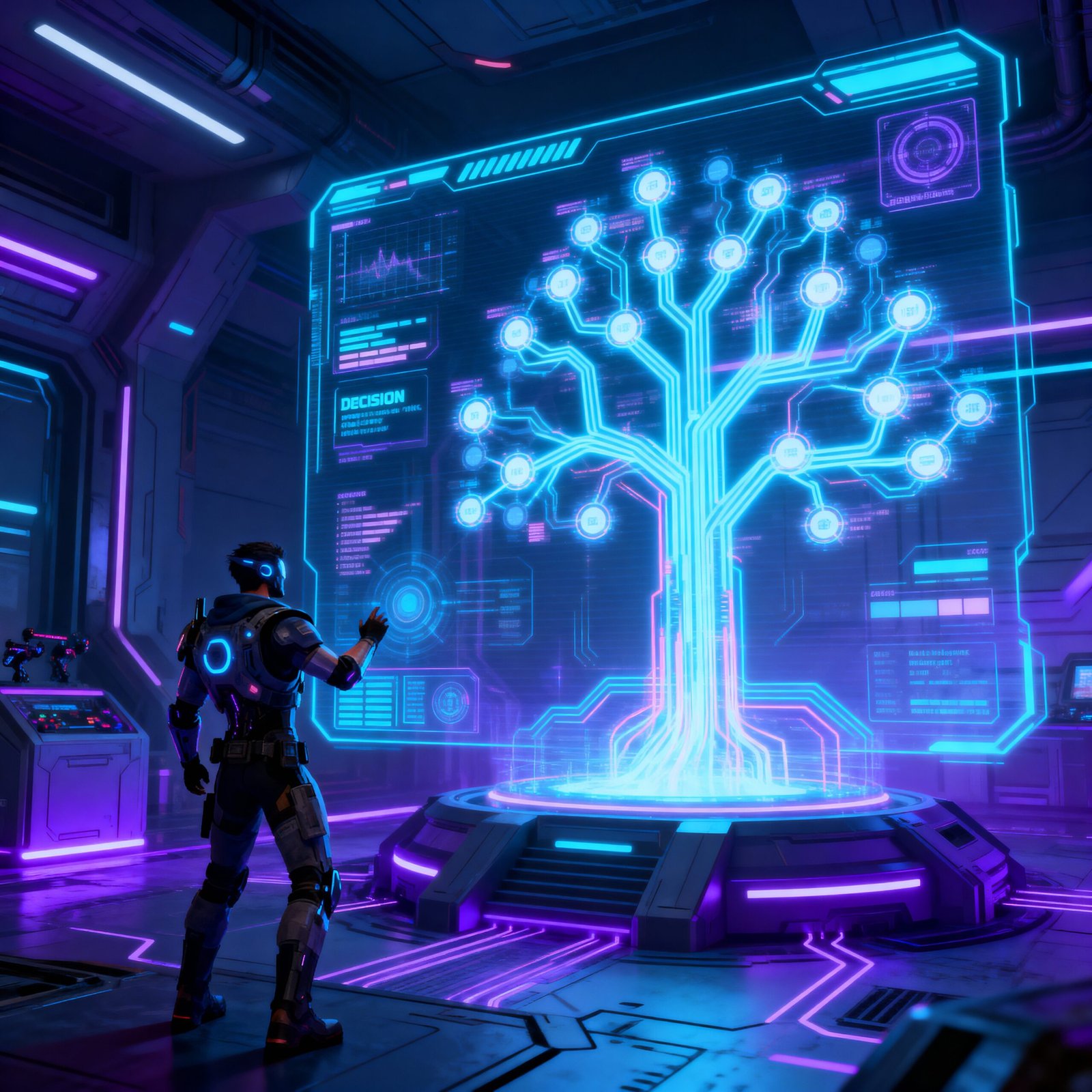
The first time I truly appreciated decision-based AI was during a late night session with Alien: Isolation. The xenomorph had cornered me in a medical bay, but instead of attacking immediately, it paused. Sniffed the air. Turned toward a locker where I’d hidden minutes earlier. That creature wasn’t following a script it was making decisions based on memory and deduction.
That moment hooked me on understanding how games create thinking characters. After years covering game development and speaking with designers at studios large and small, I’ve gained deep appreciation for the invisible decision architectures powering our favorite experiences.
What Exactly Is Decision Based AI?
Decision based AI refers to systems enabling game characters and entities to evaluate circumstances, weigh options, and select actions autonomously. Rather than following predetermined patterns, these characters process information and respond dynamically.
Think about the difference between a chess computer and a wind-up toy. Both move pieces, but one actually considers positions. Decision-based AI gives game characters that consideration ability evaluating threats, opportunities, and goals before acting.
The technology varies wildly across implementations. Some games use straightforward condition checking. Others employ sophisticated planning algorithms that chain actions toward objectives. But all share common DNA: observation, evaluation, and choice.
The Building Blocks of Game Decisions
Perception Systems
Characters can’t decide anything without first understanding their environment. Perception systems simulate sensory input sight, hearing, sometimes smell or vibration.
Splinter Cell games famously implemented detailed vision cones and light sensitivity. Guards literally couldn’t see Sam Fisher in darkness. Footsteps registered based on surface materials and movement speed. These perception models fed decision systems with realistic information constraints.
What players experience as believable guard behavior starts with believable guard perception. When characters react appropriately to stimuli, their subsequent decisions feel grounded.
Knowledge and Memory
Short term and long-term memory dramatically affect decision quality. Characters remembering previous encounters behave differently than amnesiac automatons resetting every thirty seconds.
Middle-earth: Shadow of Mordor built its entire Nemesis system around enemy memory. Orcs remembered defeats, developed grudges, and made decisions influenced by personal history with players. That orc captain who escaped your ambush? He’ll make very different tactical decisions next encounter, specifically because he recalls what worked before.
Memory creates continuity. Continuity enables meaningful decisions. Meaningful decisions produce memorable gameplay.
Evaluation Frameworks
Here’s where architectures diverge significantly. Games employ various frameworks for processing perceptions into actions.
Utility systems assign numerical scores to potential actions. A character might evaluate “attack player” at 0.7 value, “seek cover” at 0.8, and “call reinforcements” at 0.6 then select highest scoring options. These calculations happen continuously, producing fluid behavioral shifts.
Behavior trees structure decisions hierarchically. Parent nodes control evaluation flow, child nodes represent specific actions or conditions. Success or failure propagates through branches, redirecting behavior organically. Most AAA titles rely heavily on behavior tree architectures due to their visual clarity and designer accessibility.
Goal-oriented systems work backward from objectives. Need to eliminate the player? The AI identifies required steps: acquire weapon, move to firing position, aim, shoot. Planning happens dynamically, enabling emergent tactics developers never explicitly programmed.
Case Study: The Brilliance of F.E.A.R.
Monolith’s 2005 shooter remains a masterclass in decision-based AI despite its age. Soldiers in F.E.A.R. coordinate naturally, flank aggressively, and adapt when tactics fail.
The secret? Goal-oriented action planning combined with excellent communication systems. Soldiers shared knowledge about player positions, coordinated movements through squad channels, and independently developed responses to threats.
I remember watching one soldier suppress my position while his teammate circled behind my cover. When I retreated, a third enemy had already anticipated my exit route. Nothing about that encounter was scripted. Three independent decision-makers had collaborated organically.
That emergent coordination still impresses developers today. Many modern games haven’t matched F.E.A.R.’s combat AI despite eighteen years of technological advancement.
Beyond Combat: Decisions in Every Genre
Decision-based AI extends far beyond shooting enemies. Strategy games like Civilization require AI opponents weighing diplomatic, economic, and military considerations across centuries-long timescales. Sports games need realistic split-second athletic decisions. Racing opponents must choose racing lines while responding to dynamic pack positions.
The Sims franchise exemplifies non combat decision AI brilliantly. Every simulated person continuously evaluates needs, relationships, career goals, and immediate opportunities. Should your Sim eat breakfast or socialize with a housemate? The decision emerges from complex utility calculations balancing competing priorities.
Even puzzle games incorporate decision AI. Hint systems must evaluate player progress and decide when assistance improves experience versus when it robs satisfaction. That calibration requires understanding player states and making judgment calls.
Current Challenges and Limitations
Decision-based AI faces persistent obstacles despite decades of refinement.
Computational budgets remain tight. Every decision cycle competes with graphics rendering, physics simulation, and network communication for processing time. Developers constantly optimize, sometimes sacrificing decision sophistication for performance stability.
Believability creates paradoxes. Optimal decisions often feel robotic. Suboptimal decisions seem stupid. Finding the sweet spot where characters appear intelligently human requires extensive playtesting and iteration.
Debugging complex decision systems frustrates even experienced developers. When behavior emerges from interacting systems, tracing why specific decisions occurred becomes detective work. I’ve heard designers describe spending days tracking single behavioral glitches through tangled evaluation chains.
The Ethical Dimension
As decision AI grows sophisticated, ethical questions emerge. Should enemies exhibit self preservation instincts? When NPCs beg for mercy, should players feel uncomfortable? Games like Spec Ops: The Line deliberately weaponized NPC decision-making to create moral discomfort.
Manipulation concerns exist too. Dynamic difficulty systems make invisible decisions affecting player experience. Some argue players deserve transparency about when games adjust challenges. Others believe visible adjustment mechanisms break immersion.
These conversations intensify as technology advances. Decision systems increasingly influence how players feel, not just what happens. That power deserves thoughtful consideration.
Looking Forward
Decision-based AI continues evolving rapidly. Machine learning augments traditional systems, enabling characters that adapt to individual player tendencies over time. Cloud computing may eventually offload complex decision calculations, enabling richer AI without local hardware constraints.
What excites me most is growing recognition that decision AI serves entertainment, not competition. The goal isn’t creating unbeatable opponents—it’s crafting memorable experiences through believable, responsive characters.
Every year brings games with more naturalistic NPC behavior. That progress stems from talented developers refining decision architectures, understanding player psychology, and caring deeply about craft.
Frequently Asked Questions
What makes decision-based AI different from scripted behavior?
Scripted behavior follows predetermined sequences regardless of circumstances. Decision-based AI evaluates current conditions and selects responses dynamically.
Which game has the best decision-based AI?
F.E.A.R., Alien: Isolation, Halo, and The Last of Us Part II consistently receive praise for exceptional AI decision-making.
Does better AI make games harder?
Not necessarily. Well-designed decision AI creates appropriate challenges, often actively preventing frustrating difficulty spikes.
Can players exploit decision-based AI?
Yes, experienced players often identify behavioral patterns or weaknesses. Developers counter this through randomization and multiple viable decision paths.
How do developers test AI decision systems?
Combinations of automated playtesting, internal quality assurance, and extensive player feedback during development cycles.
Will decision AI ever match human intelligence?
For gaming purposes, matching human intelligence isn’t the goal—creating entertaining, believable opponents matters more than raw capability.