

I still remember the first AI system I ever built. It was 2008, and I was working on a small strategy game for a college project. My approach was embarrassingly simple just a massive collection of if-then rules. If the player builds archers, train spearmen. If resources are low, expand to new territory. If under attack, pull back defensive units.
The funny thing? It worked surprisingly well. Players thought the AI was genuinely strategic. That project taught me something important: rule-driven intelligence, despite being conceptually basic, remains incredibly powerful when implemented thoughtfully.
What Exactly Is Rule-Driven AI?
Rule-driven intelligence, sometimes called rule-based systems or expert systems in games, operates on conditional logic. You establish a set of rules that evaluate game conditions and trigger specific responses. The system checks these rules against current game state and executes matching actions.
At its core, every rule follows a simple pattern: IF condition THEN action. The magic happens in how you combine, prioritize, and structure hundreds or thousands of these rules into coherent behavior.
Think about chess AI from the 1980s. Before neural networks dominated, chess programs ran on elaborate rule sets. If opponent threatens queen, evaluate escape options. If center control is weak, prioritize pawn advancement. If king is exposed, consider castling. Grandmasters literally codified their knowledge into rules.
This approach mirrors how humans often make decisions. We don’t always engage in deep planning. Sometimes we recognize patterns and apply learned responses. Rule-based AI captures that recognition-response dynamic.
The Anatomy of Rule Systems in Games
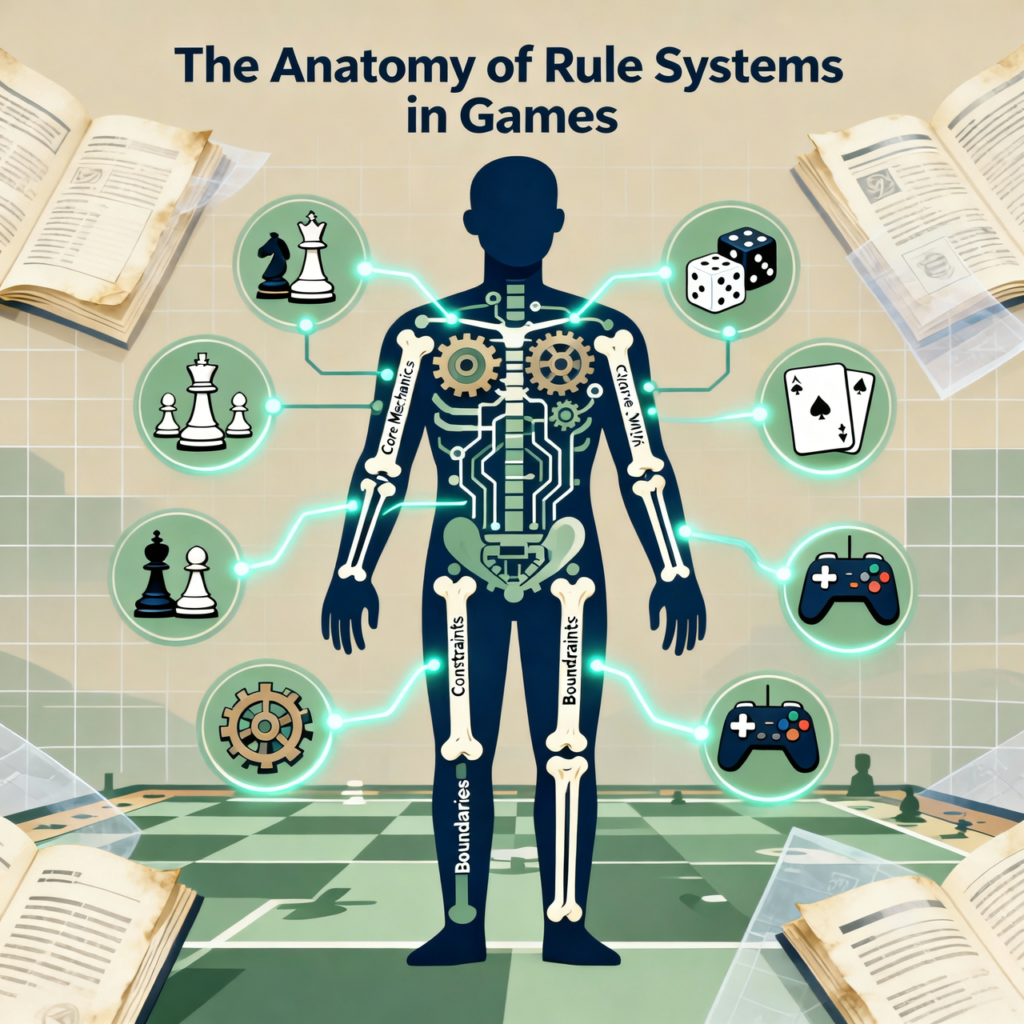
Working implementations typically include several components that work together.
The knowledge base contains all your rules. This might be hardcoded logic, external data files, or visual scripting graphs depending on your development approach. Organization matters enormously here I’ve seen projects drown in rule spaghetti when structure breaks down.
The inference engine evaluates rules against current conditions. It determines which rules fire and in what order. Some systems check all rules constantly. Others trigger evaluation only when relevant state changes. Performance considerations often drive these decisions.
Conflict resolution handles situations where multiple rules could apply. What happens when “attack nearest enemy” and “retreat when health low” both want to fire? Priority systems, recency weighting, or specificity rankings help determine which rule wins.
Working memory tracks the current game state that rules evaluate against. This might include entity positions, resource counts, relationship values, or any information relevant to decision-making.
Where Rule-Based AI Excels
Certain game genres practically beg for rule-driven approaches.
Sports games rely heavily on rules. Madden and FIFA implement player positioning, tactical adjustments, and play calling through elaborate rule sets. When the offense spreads wide, defensive backs adjust coverage. When score differential increases late in games, trailing teams become more aggressive. These rules codify real sports strategy.
The Sims franchise built its entire character behavior system on rules. Sims evaluate needs, check social situations, and select actions based on conditional logic. If hunger is high and refrigerator is nearby, get food. If friendship is low and conversation is occurring, attempt humor. The system produces remarkably lifelike daily routines from simple rules.
Strategy games use rule AI extensively. Civilization’s AI opponents follow rules about expansion, diplomacy, and military development. These rules create distinct personality profiles aggressive civilizations prioritize military rules while builders emphasize economy rules.
Card games like Hearthstone or digital poker implement opponent AI through rules evaluating hand strength, board state, and resource availability. When to play cards, when to hold back, when to bluff all encoded as conditional logic.
Crafting Effective Game Rules
After years of building these systems, I’ve developed strong opinions about what works.
Specificity beats generality. Generic rules produce generic behavior. Instead of “attack enemies,” try “attack wounded enemies first” or “prioritize enemies targeting allied healers.” Specific rules create the illusion of intelligent prioritization.
Layer your rules hierarchically. Top-level rules handle major decisions fight or flee, expand or consolidate. Lower levels handle details within those decisions. This hierarchy keeps systems manageable and mirrors how humans think.
Let designers author rules. Once I moved rule authoring out of code and into designer friendly formats, iteration speed exploded. Designers could tweak AI behavior without programmer involvement. Visual scripting tools or simple markup languages work well here.
Test extensively against varied scenarios. Rule systems can behave unexpectedly when conditions combine in ways you didn’t anticipate. I’ve watched carefully designed AI break down completely when unusual game states triggered conflicting rules.
Limitations Worth Understanding
Rule-based systems aren’t perfect. I’ve hit walls with them repeatedly.
Combinatorial explosion becomes real. As game complexity increases, rule counts multiply. Covering every meaningful situation can require thousands of rules. Maintenance becomes nightmarish.
Brittleness frustrates players. Rule systems respond only to anticipated conditions. Novel situations especially those creative players engineer can expose gaps where no rules apply. The AI stands frozen or behaves nonsensically.
No learning occurs. Rules don’t adapt to player strategies over time. Skilled players eventually recognize patterns and exploit them. The hundredth game feels identical to the tenth because the AI hasn’t evolved.
Authoring burden is substantial. Someone must think through every scenario and write appropriate rules. This requires deep game knowledge and significant time investment.
Modern Approaches and Hybrid Systems
Contemporary game AI rarely uses pure rule systems. Instead, rules integrate with other techniques.
Utility AI systems evaluate rules through scoring functions rather than binary matching. Instead of “if health low, retreat,” you might score retreat desirability based on health percentage, enemy proximity, ally support, and objective importance. The highest-scoring option wins.
Machine learning can generate rules automatically. Rather than hand-authoring, you might train systems on successful play data and extract conditional patterns. This approach appears in some racing games where AI driving behavior emerges from analyzing human replays.
Behavior trees often incorporate rule like conditional checks while providing better structure for complex decision hierarchies. Many modern games use behavior trees for flow control with rule-based logic at decision nodes.
The Enduring Value of Rules
Despite flashier alternatives, rule driven intelligence remains foundational. It’s fast to execute, straightforward to debug, and accessible to non-programmers. When I need quick, predictable AI that designers can tune directly, I still reach for rules first.
Understanding rule based systems also builds intuition for more complex approaches. Most advanced AI architectures incorporate conditional logic somewhere. The principles transfer.
Start simple. Get your rules working. Add sophistication only when simplicity fails. That approach has served me well across dozens of projects.
Frequently Asked Questions
What’s the difference between rule-based AI and finite state machines?
FSMs organize behavior into discrete states with explicit transitions. Rule systems evaluate conditions continuously and can trigger any matching rule. FSMs enforce structure; rules offer flexibility.
Are rule-based systems outdated for modern games?
No. They’re still widely used, often in combination with other techniques. Many successful games ship with primarily rule-driven AI.
How many rules does a typical game AI need?
It varies enormously. Simple enemies might need twenty rules. Complex strategy AI might require thousands. Start minimal and expand based on observed gaps.
Can rule-based AI create unpredictable behavior?
Yes, through randomization in rule selection, fuzzy condition matching, or rules that respond to complex state combinations. Predictability is a choice, not an inevitability.
What tools help build rule-based game AI?
Visual scripting tools like Unreal’s Blueprints work well. Custom solutions using JSON or XML configuration files are common. Some studios build dedicated rule editors.
Do rule systems work for multiplayer games?
Absolutely. They’re deterministic and lightweight, making them suitable for networked games where AI consistency across clients matters.