
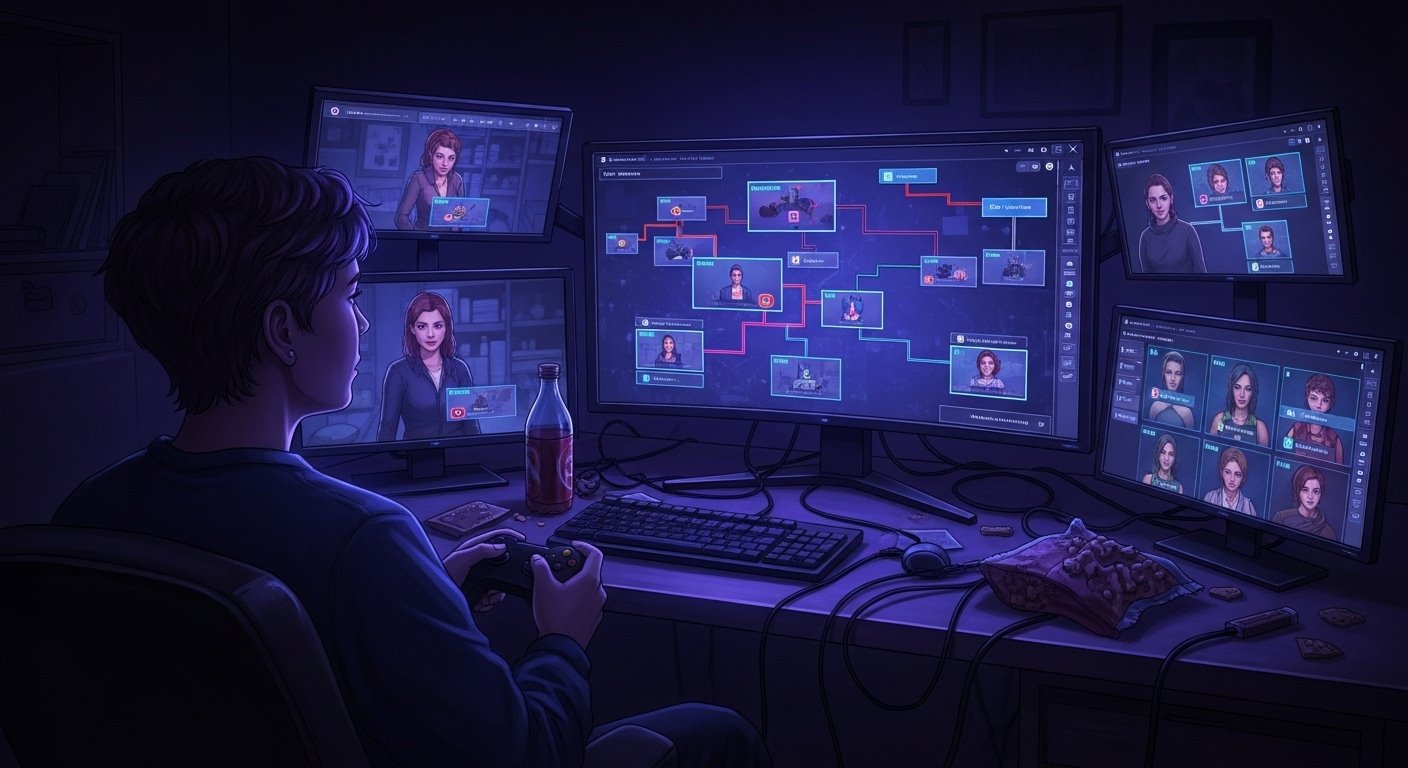
I still remember the first time I played a game where my choices genuinely seemed to matter. It was 2026, and I’d spent three hours in a dialogue heavy RPG only to realize every path led to essentially the same ending. That frustration stuck with me through years of working in interactive media, watching the industry grapple with a fundamental problem: creating meaningful branching narratives, particularly in the context of Narrative Branching Using AI in Modern Games, is extraordinarily expensive and time-consuming.
Fast forward to today, and something remarkable is happening. Artificial intelligence is beginning to solve problems that once seemed insurmountable in narrative design. Not perfectly, mind you we’re far from the science fiction dream of infinite stories but the progress is genuine and accelerating.
Understanding Narrative Branching: The Traditional Challenge

Before diving into the technological shift, it helps to understand what makes branching narratives so difficult. In traditional game development or interactive fiction, every possible story path requires manual creation. Writers must craft dialogue, designers must build scenarios, and voice actors must record lines for content most players will never see.
With advancements in AI, we are entering a new era where Narrative Branching Using AI in Modern Games is becoming a reality, offering players richer and more diverse experiences.
The mathematics get ugly fast. A story with just ten meaningful decisions, each offering two genuine paths, creates over a thousand possible narrative combinations. Triple A games sometimes employ dozens of writers working years to create what amounts to perhaps fifteen to twenty hours of actual player experience.
This resource intensity explains why many games offering “choice” actually funnel players toward predetermined outcomes. Your decisions feel important in the moment but ultimately change little. Players sense this eventually, and the illusion crumbles.
How AI Changes the Equation
Modern machine learning approaches narrative branching differently. Rather than pre scripting every possibility, these systems generate contextually appropriate responses and story developments based on player actions, established world rules, and character personalities.
Think of it like the difference between a maze with predetermined paths and a conversation with a knowledgeable friend. The maze has fixed routes. The conversation flows naturally based on what you say.
Several companies have made significant strides here. Latitude’s AI Dungeon demonstrated early possibilities, though with significant limitations around coherence and content moderation. More recently, studios have developed proprietary systems that balance generative flexibility with narrative guardrails ensuring stories remain meaningful while adapting to player choices.
The approach typically involves what developers call “bounded generation.” The AI operates within carefully designed constraints: world lore, character motivations, thematic boundaries, and narrative goals. Within those constraints, it improvises.
Real Applications in Gaming and Interactive Media

I’ve consulted with several indie studios implementing these systems, and the results vary wildly based on implementation quality. One project I observed closely used a hybrid model core story beats were traditionally written, but character interactions and side content were AI generated based on accumulated player behavior.
Players who acted aggressively found NPCs becoming more cautious around them. Those who explored thoroughly discovered contextual lore references that actually built coherently on previous discoveries. The system tracked relationship dynamics, economic decisions, even time-of-day preferences, generating appropriate narrative moments.
The cost savings were substantial. What would have required six additional writers was handled by two writers working alongside the AI system, focusing on editing, quality control, and establishing guidelines.
Netflix and other streaming platforms are exploring similar territory with interactive content. Choose your own adventure productions become vastly more feasible when AI can generate and voice peripheral dialogue branches, reserving human creative energy for pivotal moments.
Current Limitations Worth Acknowledging
Honesty matters here: we’re in early stages. Current systems struggle with several challenges that remain unsolved.
Long term narrative coherence is perhaps the biggest hurdle. AI generated story branches sometimes contradict earlier established facts or character development. Sophisticated tracking systems help, but inconsistencies emerge, particularly in lengthy experiences.
Emotional depth remains elusive. While AI can generate competent dialogue, truly moving moments the kind that make you pause the game and think still predominantly come from human writers who understand tragedy, joy, and the complicated spaces between.
There’s also the uncanny valley problem. Players sometimes sense when content is generated versus crafted. Certain patterns in phrasing, certain types of responses, create subtle wrongness even when individual sentences read fine.
Ethical Considerations and Industry Impact

The employment implications deserve direct discussion. Will AI narrative branching eliminate writing jobs? Based on my conversations with studio leads and hiring trends, the short answer is probably not but it will transform them.
Writers increasingly become architects and editors rather than pure content creators. Their job shifts toward establishing voice, maintaining quality, and designing the systems that generate narrative rather than writing every line themselves.
Content moderation presents another ethical dimension. Generative systems can produce problematic content unexpectedly. Studios must implement robust filtering without creating experiences that feel censored or inauthentic. This balance remains technically challenging and philosophically thorny.
Looking Forward: Where This Technology Is Heading
The trajectory seems clear even if timelines remain uncertain. Within five years, mid tier games will likely incorporate meaningful AI driven narrative adaptation as standard practice. AAA studios are already prototyping systems for major releases.
Interactive fiction may experience a renaissance. Genres that died due to production costs complex branching visual novels, deeply reactive RPGs, personalized adventure games become economically viable again.
What excites me most is democratization. Independent creators and small studios gain access to narrative complexity previously requiring million dollar budgets. The barrier between imagination and implementation lowers considerably.
Final Thoughts
Narrative branching using AI isn’t replacing human creativity it’s amplifying it. The technology handles branching complexity while humans focus on meaning, emotion, and vision. That partnership, when executed thoughtfully, produces experiences neither could achieve alone.
We’re witnessing the early chapters of this shift. The stories that emerge will surprise us.
Frequently Asked Questions
What is narrative branching in storytelling?
Narrative branching refers to story structures where reader or player choices create different plot paths, leading to varying outcomes, character relationships, and endings.
How does AI improve branching narratives?
AI generates contextual story content dynamically rather than requiring every possibility to be pre written, dramatically reducing production costs while increasing personalization.
Can AI completely replace human writers for interactive stories?
Not currently. AI struggles with emotional depth, long term coherence, and subtle characterization. Human oversight remains essential for quality experiences.
Which games currently use AI narrative branching?
Several indie titles and experimental projects use these systems. Major studios are developing proprietary solutions, though specific implementations remain largely confidential.
Is AI-generated narrative content as good as human written?
Quality varies significantly. AI excels at peripheral content and adaptive responses but still falls short for pivotal emotional moments and complex character development.
What are the main challenges with AI narrative systems?
Key challenges include maintaining story coherence over time, preventing content that contradicts established facts, and avoiding uncanny valley effects in dialogue.