

I’ll never forget the first time I watched an AI model accurately predict a massive price swing in a virtual marketplace. It was 2026, and I was consulting for a gaming company struggling with hyperinflation in their in game economy. Traditional economic models weren’t cutting it too many variables, too much player behavior chaos. Then we brought in machine learning, and suddenly patterns emerged from what looked like complete randomness.
That experience opened my eyes to how AI is fundamentally changing how we understand and predict virtual economies. Whether we’re talking about massively multiplayer online games, cryptocurrency markets, or emerging metaverse platforms, the stakes are higher than ever, and the tools we’re using to forecast these digital marketplaces have become remarkably sophisticated.
Understanding Virtual Economies in the First Place

Before diving into AI’s role, let’s get grounded in what makes virtual economies tick. These aren’t toy systems anymore. Counter Strike skins trade for thousands of dollars. Axie Infinity created actual income streams for players in developing countries. Decentraland plots sell for six figures. These economies involve real money, real livelihoods, and real consequences when things go wrong.
What makes them particularly challenging to predict? Unlike traditional markets bound by physical constraints and regulatory frameworks, virtual economies are influenced by game updates, community sentiment on Discord servers, influencer tweets, exploit discoveries, and developer decisions that can change the rules overnight. I’ve seen economies tank because a single YouTube creator stopped playing a game.
How AI Actually Predicts Virtual Market Movements
The prediction models I’ve worked with typically combine several approaches. First, there’s time series analysis looking at historical price data, transaction volumes, and player activity metrics to identify patterns. But here’s where it gets interesting: modern AI systems layer on natural language processing to analyze community sentiment from forums, social media, and chat logs.
One platform I evaluated used recurrent neural networks (RNNs) to process transaction data from a blockchain based game. The model tracked not just price movements but wallet behavior who was accumulating, who was dumping, which addresses belonged to whales versus casual players. The accuracy was unsettling. It could forecast price movements 6-12 hours out with about 70% accuracy, which in volatile crypto game markets is genuinely useful.
Another system employed ensemble methods, combining multiple algorithms to predict supply and demand shifts in a virtual real estate market. It factored in user login patterns, geographic player distribution, seasonal trends, and even external factors like cryptocurrency market conditions. When Bitcoin crashed in 2026, this model correctly predicted corresponding drops in metaverse land values days before they happened.
Real World Applications I’ve Encountered
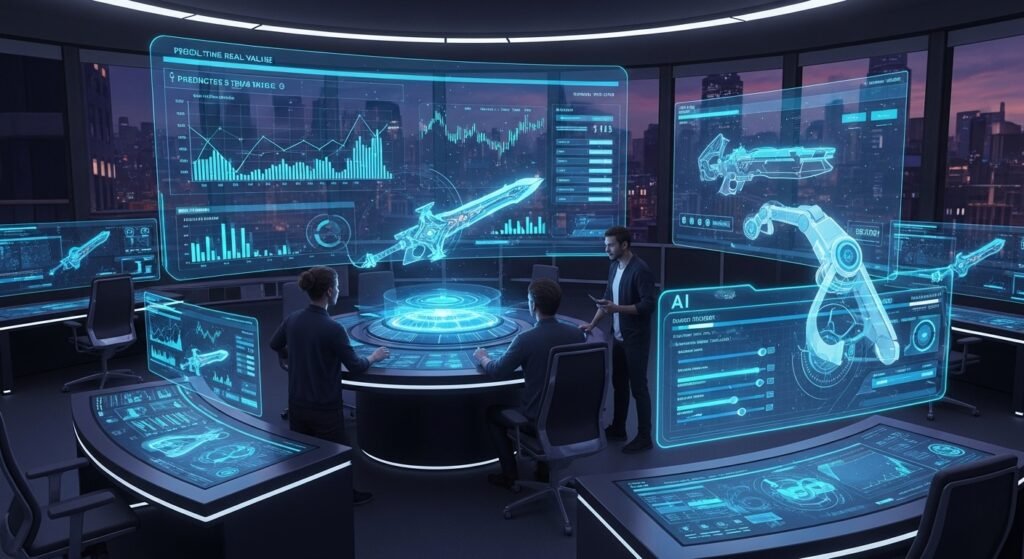
Gaming companies use these tools primarily for balance and retention. If an AI model predicts that introducing a new legendary weapon will crash the value of existing items by 40%, developers can adjust rarity or stats before launch. I worked with one studio that used predictive models to optimize their gacha system rates controversial from a player perspective, absolutely, but they reduced player churn by smoothing out the economic volatility that drove people away.
Virtual world platforms leverage AI prediction for urban planning, essentially. If models forecast that a particular district will become high traffic based on upcoming features or creator activity, the platform might adjust land pricing or infrastructure investment accordingly.
Traders and investors in NFT and blockchain gaming spaces use proprietary prediction tools constantly. I know folks running bots that execute trades based on AI forecasts, though the effectiveness varies wildly depending on market maturity and liquidity.
The Limitations Nobody Likes to Talk About
Here’s the uncomfortable truth: these systems fail. Often. I’ve seen beautifully architected models produce garbage predictions because they didn’t account for something as simple as a holiday weekend or a developer being sick and delaying a patch.
Virtual economies are subject to “black swan” events that no amount of historical data can predict. A major hack, a regulatory announcement, a pandemic shifting everyone to online gaming these fundamentally reshape the landscape in ways algorithms trained on pre-event data simply can’t anticipate.
There’s also the problem of market manipulation. When prediction models become known and trusted, savvy actors game them. I’ve watched coordinated groups intentionally create false signals pumping social media sentiment, executing wash trades specifically to trick prediction algorithms into forecasting trends that they then exploit.
The feedback loop issue is real too. If enough people trust an AI prediction that says an item’s value will rise, they buy it, which makes it rise, which “validates” the prediction. But was the model actually predicting organic market forces, or did it create a self-fulfilling prophecy? This philosophical question keeps me up sometimes.
Ethical Considerations Worth Your Attention

We need to talk about fairness. When game companies use AI to predict and manipulate their economies, are they creating entertainment or exploiting psychological vulnerabilities? I’ve been in meetings where the explicit goal was maximizing revenue extraction through predictive modeling of player spending patterns. It felt gross.
There’s also information asymmetry. If a platform operator has access to sophisticated prediction tools that regular users don’t, they can essentially print money by front running the market. Some platforms I’ve reviewed have policies against this, but enforcement is murky.
And what about the players in developing economies who depend on virtual world income? When an AI optimized change tanks an economy’s value, real families suffer. The responsibility that comes with these prediction capabilities isn’t always taken seriously enough.
Where I See This Heading
The integration of large language models into economic prediction is already happening. Systems that can parse developer blog posts, community speculation, and even game code repositories to predict upcoming changes before they’re officially announced. The edge these provide is substantial.
I’m also watching cross platform predictive models with interest. Systems that recognize patterns across multiple virtual economies and apply learnings from one to another. A monetization strategy that caused inflation in Game A might trigger predictions about similar mechanics in Game B.
The really ambitious projects are building “digital twin” economies complete AI simulated versions of virtual marketplaces where you can test interventions before implementing them in the live environment. It’s like a flight simulator for economic policy.
Practical Takeaway
If you’re building a virtual economy, treating AI prediction as a magic bullet is a mistake. Use it as one tool among many. Combine model outputs with human judgment, community feedback, and ethical oversight. And for heaven’s sake, maintain manual override capabilities for when the models inevitably miss something crucial.
If you’re a participant in these economies whether playing, trading, or investing understand that you’re increasingly competing against or alongside AI systems. That doesn’t mean you can’t win, but awareness of how these prediction tools work gives you better perspective on market movements.
Virtual economies are here to stay, growing in economic significance every year. AI prediction tools are becoming more sophisticated and widely deployed. The intersection of these two trends is creating opportunities and challenges we’re still learning to navigate. From where I sit, having spent years in these spaces, we’re still in the early chapters of this story.
FAQs
Q: How accurate are AI predictions for virtual economies?
A: Accuracy varies widely from 60-80% for short term predictions in stable environments, but drops significantly during major events or updates. No system is consistently reliable across all conditions.
Q: Can individual players access these prediction tools?
A: Some tools are publicly available, especially for cryptocurrency and NFT markets, but the most sophisticated systems are proprietary. Open source alternatives exist but require technical expertise to implement.
Q: Do AI predictions work for all types of virtual economies?
A: They work best in high liquidity markets with substantial historical data. New or small economies don’t provide enough data for reliable predictions.
Q: Is it legal to use AI for virtual economy trading?
A: Generally yes, though specific game terms of service may prohibit automated trading. Cryptocurrency regulations vary by jurisdiction and are evolving.
Q: What’s the biggest risk of relying on AI predictions?
A: Over confidence leading to poor decision making, especially when models fail to account for unprecedented events or are manipulated by bad actors who understand how they work.