
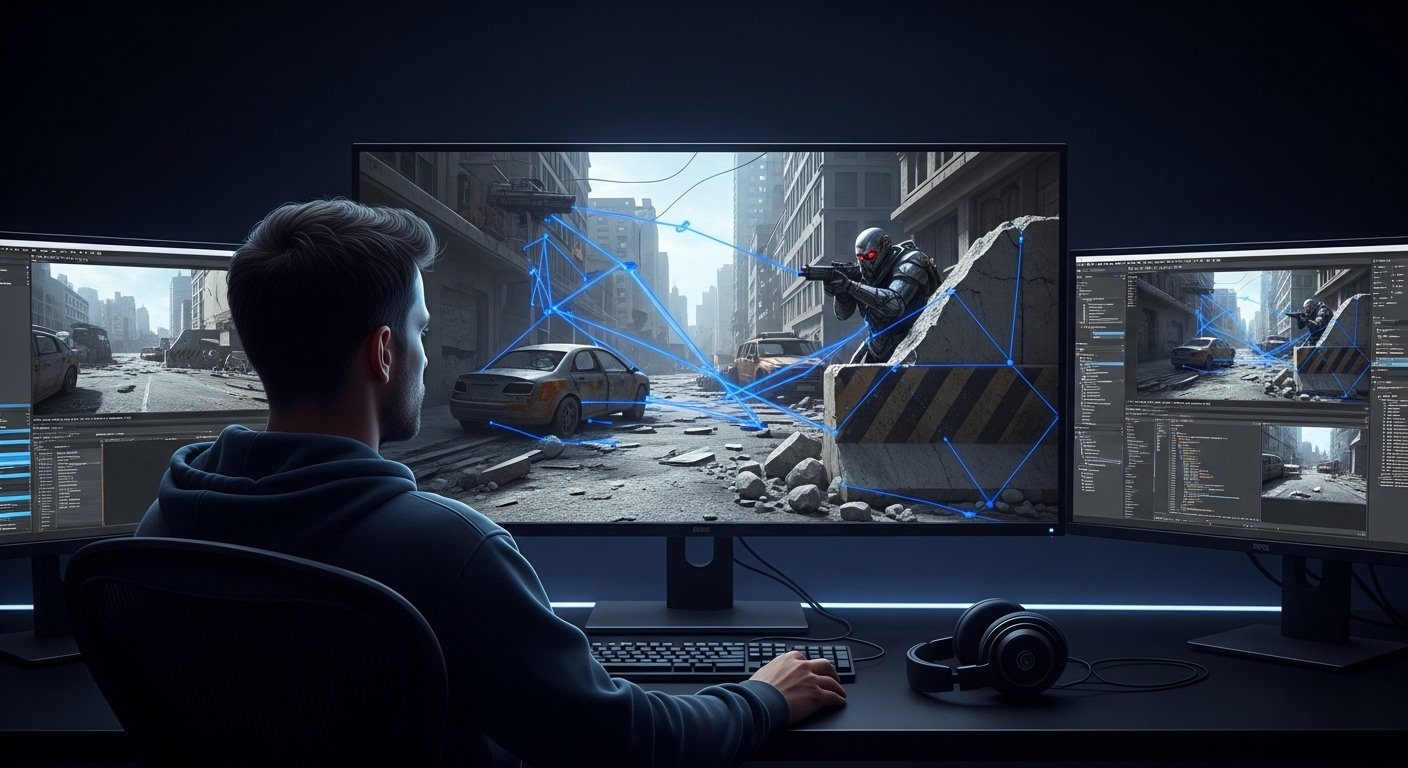
I still remember the first time I watched an NPC in a game I was working on actually surprise me. After weeks of tweaking behavior trees and adjusting probability weights, the enemy character flanked my position in a way I hadn’t explicitly programmed. That moment crystallized something important about game AI when done right, it creates emergent behavior that feels genuinely alive.
Over the past decade working in game development, I’ve seen AI techniques evolve from simple if-then statements to sophisticated systems that can adapt, learn, and create experiences that rival human game masters. Let me walk you through the core techniques that actually matter in modern game development.
The Foundation: Pathfinding Algorithms

Every game developer starts here. Pathfinding is the bread and butter of game AI, and the A algorithm remains the industry workhorse for good reason. It’s elegant, efficient, and incredibly flexible.
But here’s what tutorials don’t tell you: raw A rarely survives contact with a real game. You’ll spend weeks optimizing it. Navigation meshes have become the standard approach for 3D games because they simplify complex environments into traversable polygons. Unity’s NavMesh system and Unreal’s AI navigation tools build on this foundation.
I worked on a stealth game where we needed guards to patrol naturally. Simple waypoint systems looked robotic. The solution was layered A for basic navigation, combined with context steering to avoid obstacles smoothly, and randomized patrol variations to prevent predictability. The guards finally looked like they belonged in that world.
Finite State Machines: Still Relevant After All These Years
FSMs get dismissed as “outdated” by newcomers, but they’re everywhere in shipped games. Why? Because they work, they’re debuggable, and junior programmers can understand them in an afternoon.
A typical enemy FSM might include states like Idle, Patrol, Alert, Chase, and Attack. Transitions between states are triggered by conditions seeing the player, hearing a noise, losing line of sight. Simple, predictable, maintainable.
The limitation is scalability. Once you’re dealing with twenty states and dozens of transitions, FSMs become spaghetti. That’s when you graduate to something more sophisticated.
Behavior Trees: The Industry Standard

If you’re serious about game AI, behavior trees are non negotiable. They’ve dominated A development for over a decade, and for good reason.
The structure is intuitive once you grasp it. Behavior trees use nodes organized hierarchically selectors choose between options, sequences execute steps in order, and leaf nodes perform actual actions or checks. The elegance is in the modularity. You can drag and drop behaviors, reuse subtrees across different character types, and debug visually.
Halo 2 popularized behavior trees in games, and they’ve only gotten more sophisticated. Modern implementations include utility AI concepts, where behaviors are scored based on relevance and the highest scoring option wins. This creates more organic decision making without exponential complexity growth.
One project I consulted on used behavior trees with blackboard systems shared memory spaces where AI characters post and read information. Guards would write “suspicious noise at location X” to the blackboard, and nearby guards could respond appropriately. Suddenly, enemies felt coordinated without explicit communication code.
Machine Learning: Promise and Reality

Let’s be honest about machine learning in games. It’s powerful but often impractical for real time decision making in shipped products. Training times, hardware requirements, and unpredictable behavior make pure ML solutions risky.
That said, ML excels in specific applications. Procedural animation systems like those in FIFA use ML to blend motion capture data realistically. Racing games employ neural networks to create adaptive AI drivers. And testing ML agents can explore game spaces to find bugs humans would miss.
Reinforcement learning captured imaginations when OpenAI’s bots played Dota 2, but those required computational resources unavailable to typical studios. The practical applications tend to be offline training during development, then deploying simplified models or extracted rule sets.
Procedural Content Generation
PCG isn’t traditional AI, but the lines have blurred significantly. Techniques range from simple randomization to sophisticated generative systems.
Spelunky’s level generation uses a constraint-based approach rooms are assembled from templates following rules ensuring playability. No Man’s Sky generates entire planets using mathematical functions and seed values. Dwarf Fortress creates complex histories and civilizations through simulation.
The recent integration of machine learning with PCG opens fascinating possibilities. Wave Function Collapse algorithms can generate coherent content by analyzing example assets. Systems can learn level design principles from human-created content and apply them to generate new variations.
Practical Considerations
Debugging AI is harder than debugging traditional code. The behavior might be “correct” according to your logic but feel wrong to players. Build visualization tools early show decision processes, current states, and relevant perception data during development.
Performance matters enormously. Sophisticated AI running on every NPC will tank your frame rate. Budget AI processing across frames, implement level of detail systems where distant characters use simpler logic, and profile religiously.
Player perception trumps technical sophistication. A predictable enemy with good animations often feels smarter than a complex system with poor feedback. Polish the player facing elements first.
Looking Forward
The most exciting developments combine multiple techniques. Utility AI provides flexible decision making, behavior trees organize actions, ML handles animation and adaptation, and procedural systems generate variety. Each tool excels at different aspects.
Games like The Last of Us Part II demonstrate how far we’ve come enemies communicate, coordinate, and respond dynamically to player actions. Yet they’re built on the same fundamental techniques discussed here, just masterfully combined and polished.
The barrier to entry has never been lower. Free engines include sophisticated AI tools. Open source libraries cover everything from pathfinding to behavior trees. The challenge isn’t access to techniques it’s wisdom in applying them.
FAQs
What’s the best AI technique for beginner game developers?
Start with finite state machines. They’re simple to implement, easy to debug, and teach fundamental AI concepts before tackling complex systems.
Is machine learning replacing traditional game AI?
Not currently. ML complements traditional techniques but can’t replace them for real time gameplay decisions due to computational costs and unpredictability.
How do AAA games make enemies feel smart?
Combination of good animation, audio feedback, behavior trees, utility scoring, and extensive playtesting. Perception of intelligence matters as much as actual complexity.
What programming language is best for game AI?
C++ dominates AAA development. C# works well with Unity. Python suits prototyping and ML training. Choose based on your engine and project needs.
How long does it take to implement competent game AI?
Basic enemy AI might take days. Sophisticated systems with multiple character types, coordination, and emergent behavior can require months of iteration.