

I still remember the moment that completely changed how I thought about game AI. It was 2026, and I was playing Red Dead Redemption 2. A random NPC remembered that I’d bumped into him three hours earlier and actually called me out for it. That wasn’t scripted. That was an advanced behavior system doing exactly what it was designed to do create the illusion of real people inhabiting a virtual world.
After spending nearly a decade working on character AI systems across multiple studios, I’ve watched NPC behavior evolve from simple patrol routes to complex decision making entities. Let me break down what actually goes into building these systems and why they matter more than ever.
What Makes NPC Behavior “Advanced”?
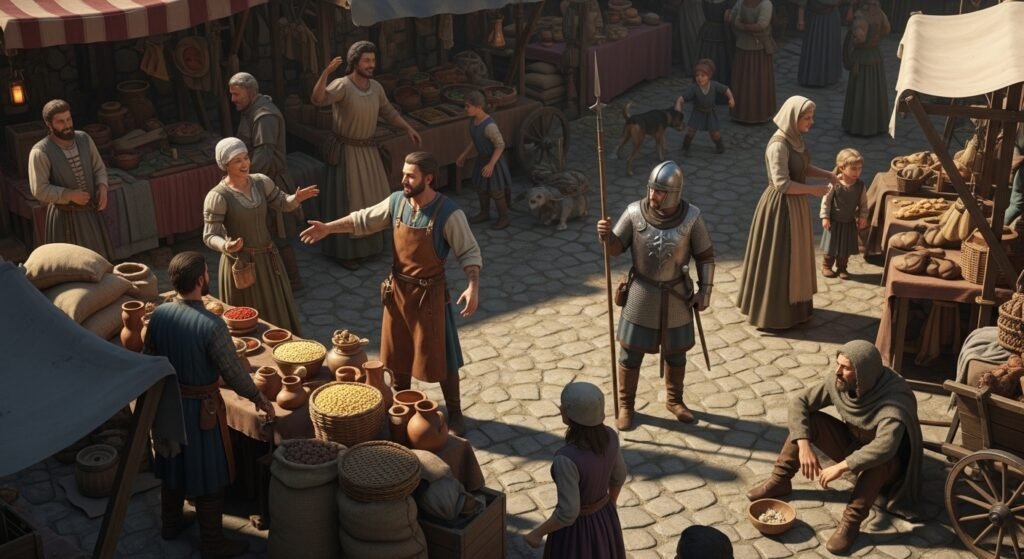
Basic NPCs operate on predictable loops. Walk from point A to point B. Attack when the player gets close. Die. Repeat. We’ve all seen this pattern countless times, and frankly, it breaks immersion faster than anything else.
Advanced NPC behavior systems fundamentally change this equation. They create characters that respond dynamically to environmental changes, remember past interactions, adapt their strategies based on outcomes, and exhibit what players perceive as personality.
The difference isn’t just technical it’s emotional. When an NPC behaves believably, players form connections. They hesitate before attacking. They remember encounters. That’s powerful stuff.
The Core Architecture: Beyond Simple State Machines
Finite State Machines dominated game AI for decades. They’re straightforward: an NPC exists in one state at a time and transitions based on triggers. Patrolling becomes chasing when the player is spotted. Chasing becomes attacking at close range. Simple enough.
But FSMs scale terribly. Adding complexity means exponentially more states and transitions. I’ve seen codebases where a single enemy type had over 200 states. Debugging that nightmare taught me why the industry moved toward better solutions.
Behavior Trees: The Industry Standard
Behavior trees revolutionized NPC design. Instead of managing states, developers create hierarchical decision structures. Each branch represents possible actions, evaluated from left to right until something succeeds.
The beauty lies in modularity. Want your guard NPC to investigate sounds? Slot in an investigation subtree. Need them to flee when health drops low? Add a selector node with a health check. Behavior trees made complex AI manageable and, critically, debuggable.
Games like Halo 2 pioneered this approach, and it remains the backbone of most modern titles. The system I helped build for a stealth game used behavior trees with around 150 nodes per enemy type sounds complex, but each piece was independently testable.
Goal Oriented Action Planning (GOAP)
F.E.A.R. introduced GOAP to mainstream game development back in 2026, and its influence persists today. Rather than prescribing behaviors, GOAP systems give NPCs goals and let them figure out how to achieve them.
Here’s the concept: an NPC wants to kill the player. They have available actions take cover, flank, throw grenade, reload, advance. Each action has preconditions and effects. The planning system chains actions together backward from the goal, finding valid sequences in real-time.
The results feel surprisingly organic. NPCs appear to think because, in a limited sense, they actually do. They adapt when expected approaches fail. One playthrough, an enemy might flank left; next time, they might suppress while teammates move.
Utility AI: When Everything Has Value
Utility based systems assign numerical scores to every possible action. The NPC evaluates options based on current circumstances and chooses whatever scores highest.
This approach excels at creating personality variations. An aggressive NPC weights offensive actions higher. A cautious one prioritizes survival related behaviors. Same underlying system, completely different feel.
The Sims franchise exemplifies utility AI at scale. Every interaction, every object, every social opportunity generates scores based on a Sim’s needs, personality, and relationships. The complexity emerges from simple math applied broadly.
Context and Memory: The Missing Pieces

Technical systems only matter if NPCs understand their world. Advanced behavior requires robust perception and memory components.
Modern perception systems simulate what NPCs actually know versus what exists in the game. Line of sight calculations, hearing ranges, attention limits these constraints create believable limitations. An enemy shouldn’t somehow know you’re behind them unless they have reason to.
Memory transforms individual encounters into persistent relationships. That merchant you robbed remembers. The guard you bribed might become an ally later. These systems store interaction histories and influence future behavior accordingly.
Real World Implementation Challenges
Building these systems sounds elegant on paper. Reality involves constant tradeoffs.
Performance constraints hit hard. Running complex decision-making for dozens of NPCs simultaneously crushes frame rates. Optimization techniques like level of detail AI simpler behaviors for distant characters help but introduce their own complications.
Balancing believability against playability presents constant tension. NPCs that behave too realistically become frustrating. Perfect aim, optimal tactics, and flawless coordination make games unwinnable. Sometimes intentionally dumb AI serves players better.
Testing emergent behavior systems borders on impossible. When NPCs make independent decisions, unexpected combinations create bugs that only appear under specific circumstances. I once spent three weeks tracking a crash that only occurred when two specific enemy types tried to flank simultaneously during rain.
The Future: Machine Learning and Beyond

Procedural behavior generation represents the next frontier. Rather than hand crafting every decision tree, developers increasingly explore training NPCs through simulation.
Some studios experiment with neural networks that learn effective behaviors from thousands of playthroughs. The results show promise but raise questions about consistency and controllability. Players expect reliable experiences; machine learning introduces variability that’s difficult to guarantee.
What excites me most isn’t replacing traditional systems but augmenting them. Hybrid approaches using learned components for specific subtasks combat timing, dialogue response selection while maintaining designed frameworks for overall behavior seem most promising.
Conclusion
Advanced NPC behavior systems represent game development at its most interdisciplinary. They combine psychology, computer science, storytelling, and design into something genuinely magical when executed well.
The goal hasn’t changed since those early scripted encounters: make players believe these digital characters have inner lives. The tools have simply evolved to match our ambitions.
Frequently Asked Questions
What programming languages are commonly used for NPC AI systems?
C++ remains dominant in AAA development due to performance requirements. Unity developers typically use C#, while smaller projects might leverage Python for prototyping before optimization.
How do NPCs detect players in stealth games?
Most systems combine sight cone calculations, sound propagation models, and alert state machines. Environmental factors like lighting and cover modify detection rates dynamically.
Can NPCs actually learn during gameplay?
Most commercial games use predetermined behaviors rather than runtime learning. Some experimental titles implement limited adaptation, but consistency concerns limit widespread adoption.
What’s the difference between scripted and emergent behavior?
Scripted behavior follows predetermined sequences triggered by specific events. Emergent behavior arises from systems interacting, creating unplanned but coherent outcomes.
Why do enemy NPCs sometimes seem artificially stupid?
Intentional limitations often serve gameplay. Perfect AI would frustrate players. Designers deliberately introduce delays, accuracy penalties, and suboptimal decisions to maintain challenge balance.
How much development time do NPC systems typically require?
Complex behavior systems often require 6-18 months of dedicated work, though iterations continue throughout production. Simpler games might implement basic AI in weeks.