

There’s a moment I remember vividly from my first playthrough of Red Dead Redemption 2. I was riding through the Heartlands, minding my own business, when a stranger on horseback flagged me down. His horse had thrown a shoe, and he needed a lift to town. I obliged, and we chatted along the way. Nothing scripted felt about it just a random encounter that made the world feel genuinely alive.
That experience stuck with me because it represents something remarkable happening in game development: AI dynamic event systems that generate meaningful, contextual experiences without direct designer intervention for every scenario.
Understanding Dynamic Event Systems

At their core, dynamic event systems are sophisticated frameworks that generate, trigger, and manage in game occurrences based on various factors player behavior, world state, time progression, and environmental conditions. Unlike traditional scripted events that play out identically every time, these systems create emergent situations that respond to the actual game context.
Think of it like this: a scripted event is a movie scene. A dynamic event is more like improv theater where actors know their characters and respond to whatever the audience throws at them.
The “AI” component doesn’t necessarily mean machine learning, though modern implementations increasingly incorporate it. More often, it refers to intelligent rule based systems, behavior trees, and probability engines working together to create convincing spontaneity.
The Mechanics Behind the Magic
Having spent years analyzing how different studios approach this challenge, I’ve noticed several common architectural patterns.
Most dynamic event systems operate on a trigger condition action framework. The system constantly monitors game state variables player location, inventory, quest progress, NPC relationships, even weather conditions. When specific conditions align, potential events enter a selection pool. The AI then evaluates which events make narrative sense, won’t conflict with ongoing activities, and offer appropriate challenge or reward.
Left 4 Dead’s “AI Director” remains a landmark example. It doesn’t just spawn zombies randomly; it reads player stress levels through health, ammo, and recent combat intensity. Struggling? Fewer hordes. Cruising through? Here come the special infected. This creates organic difficulty curves that feel fair rather than punishing.
Shadow of Mordor took things further with the Nemesis System. Orc captains remember their encounters with you. That grunt who killed you early in the game? He’s now a captain, probably scarred from your previous battle, and he definitely remembers. The system generates personal narratives that no designer explicitly wrote.
Why Players Can’t Get Enough
The appeal comes down to something fundamental about human psychology: we crave novelty within familiarity. We want game worlds that surprise us but still make internal sense.
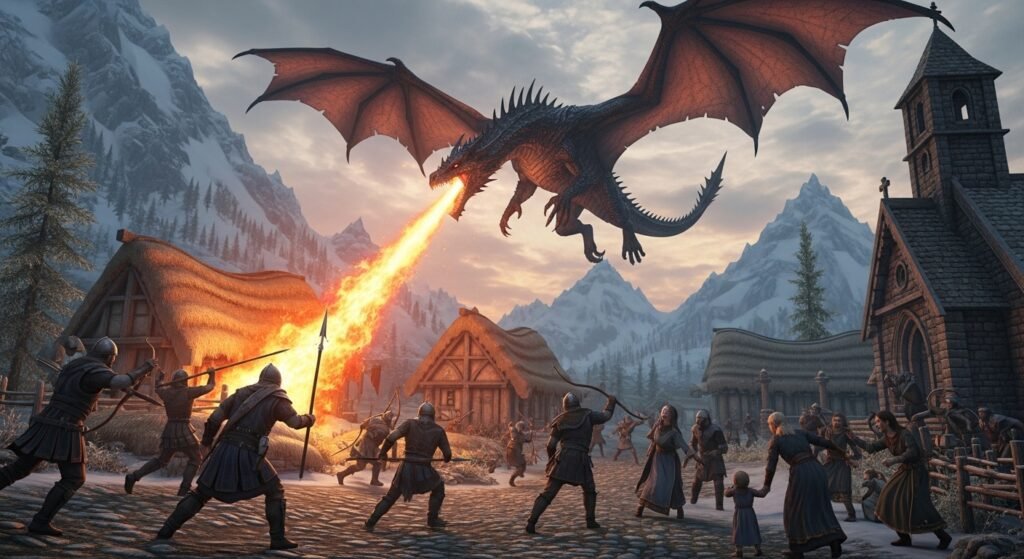
Dynamic events deliver on this beautifully. Random doesn’t mean arbitrary. A well designed system ensures that a dragon attack in Skyrim happens at dramatically appropriate moments, not while you’re managing inventory in a shop. Bandits ambush you on lonely roads, not in city centers surrounded by guards.
This creates stories worth sharing. When players discuss their experiences online, they’re often recounting emergent moments that time everything went wrong in XCOM, when an unexpected raid derailed their carefully planned evening in a survival game, or when NPCs behaved in unexpectedly human ways.
Real World Implementation Challenges
Here’s what marketing materials won’t tell you: building these systems is brutally difficult.
Balance represents the biggest headache. Make events too frequent, and the world feels chaotic, overwhelming. Too sparse, and players question why the system exists at all. I’ve watched promising games sabotage themselves by not finding this sweet spot.
There’s also the coherence problem. Generated events must fit the established world logic. A random alien invasion in a medieval fantasy setting would shatter immersion instantly, regardless of how technically impressive the generation system might be.
Performance constraints add another layer. These systems run continuous evaluations, checking conditions, managing probability tables, tracking countless variables. On console hardware especially, developers must constantly optimize to prevent frame drops during complex event calculations.
The most underestimated challenge? Testing. How do you QA something designed to be unpredictable? Studios invest enormous resources into automated testing suites that simulate thousands of playthroughs, but edge cases inevitably slip through.
Current Industry Trends
The past few years have seen fascinating developments. Procedural narrative generation has matured significantly, with games like Dwarf Fortress and RimWorld demonstrating that compelling stories can emerge from systemic interactions rather than authored content.
We’re also seeing more sophisticated player modeling. Games increasingly track individual play patterns to customize event timing and type. Prefer exploration? The system might generate more discovery-focused events. Combat focused? Expect more confrontations.
Cloud computing opens new possibilities too. Some developers experiment with server side event calculation, allowing more complex simulations without taxing local hardware.
Looking Ahead
The trajectory seems clear: dynamic systems will become more personalized, more responsive, and harder to distinguish from carefully authored content.
Machine learning models trained on player data could eventually predict what kinds of events would resonate most with individual players. We might see systems that understand narrative pacing at a deeper level, knowing when tension should build versus when players need breathing room.
But there are legitimate concerns about this direction. How much data collection is acceptable? When does personalization become manipulation? These ethical questions deserve serious consideration as the technology advances.
Final Thoughts
Having followed this field for over a decade, what excites me most isn’t the technology itself it’s what it enables. Great dynamic event systems disappear into the experience. Players don’t think about probability tables or behavior trees; they just feel like they’re inhabiting a living world that responds to their presence.
That stranger who needed a ride to town in Red Dead? I still remember him. Not because of technical wizardry, but because for a moment, the game felt less like software and more like somewhere I’d actually been.
FAQs
What exactly triggers dynamic events in games?
Multiple factors including player location, game progress, time elapsed, random probability weights, and contextual conditions like combat status or inventory state.
Do all open world games use dynamic event systems?
Most modern open world titles incorporate some form of dynamic events, though complexity varies significantly between implementations.
Can players disable dynamic events?
Some games offer options to adjust event frequency, though completely disabling them often removes core gameplay elements.
How do dynamic events differ from random encounters?
Dynamic events consider game context and player state, while random encounters typically rely on simpler probability checks without contextual awareness.
Do dynamic events affect game performance?
Yes, though well optimized systems minimize impact. Older hardware may experience slight performance dips during complex event calculations.
Which game has the best dynamic event system?
This is subjective, but Shadow of Mordor’s Nemesis System and Left 4 Dead’s AI Director are frequently cited as industry benchmarks.