
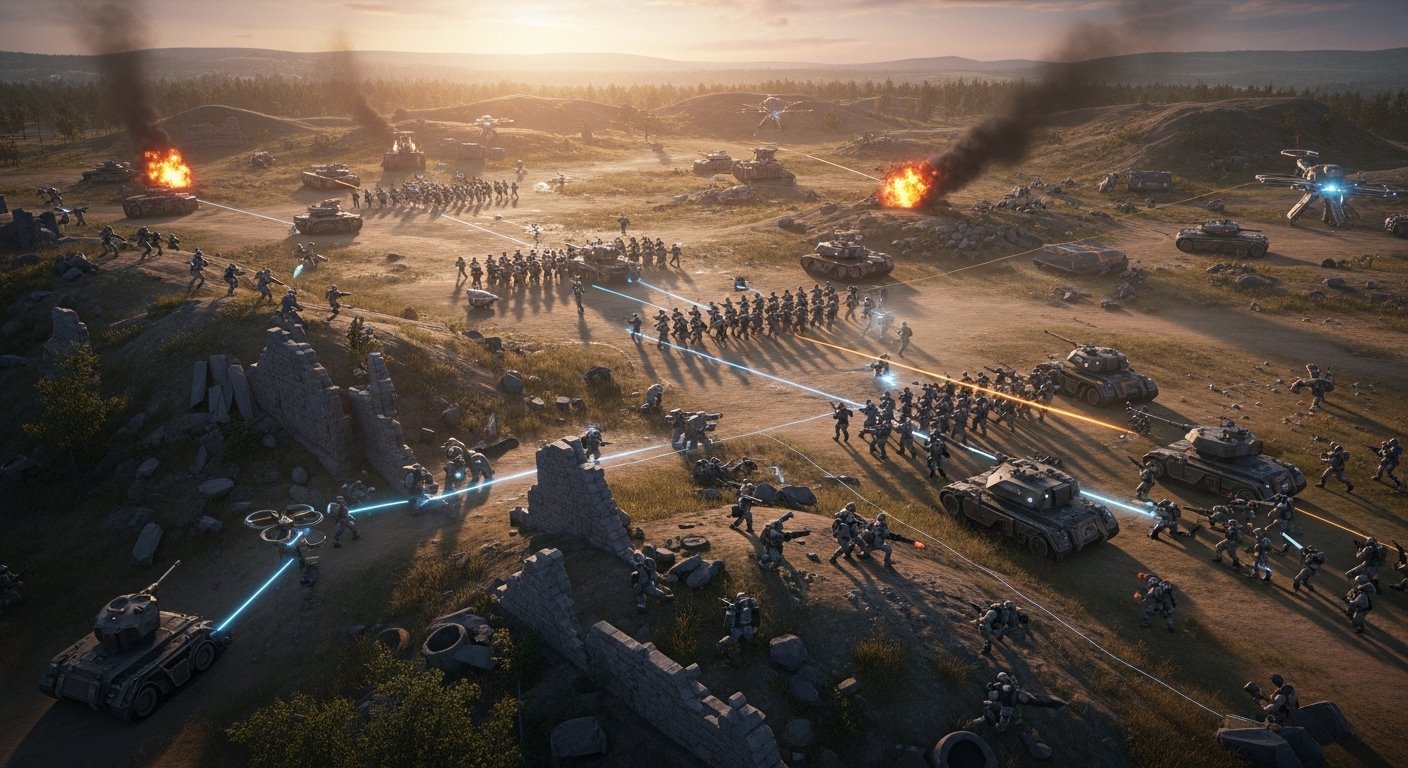
There’s something uniquely satisfying about watching an enemy army crumble under the weight of your carefully planned assault. But have you ever paused mid battle and wondered how that opponent controlled entirely by the game knew exactly when to flank your forces or retreat before catastrophic losses?
After spending over a decade studying game design and working alongside developers who craft these systems, I’ve developed a deep appreciation for the complexity hiding behind every computer controlled opponent. Real time strategy AI isn’t just about making enemies that move and attack. It’s about creating the illusion of intelligence under extreme time constraints.
The Unique Challenge of RTS Decision Making
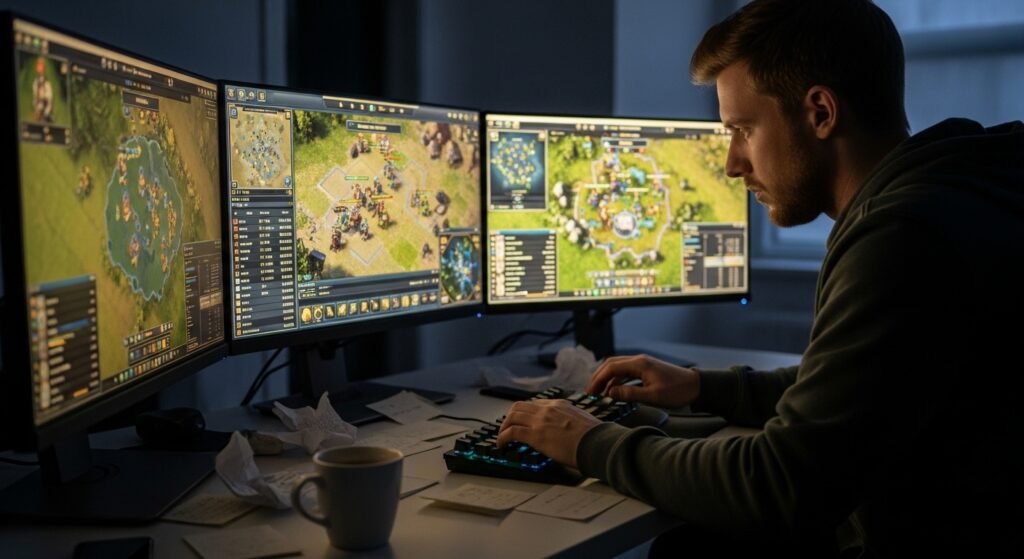
Real time strategy games present one of the most demanding environments for artificial intelligence in gaming. Unlike turn based games where the computer can take its time calculating optimal moves, RTS games demand instant responses. Milliseconds matter.
Consider what an RTS AI must handle simultaneously: resource gathering, base construction, unit production, scouting, threat assessment, tactical positioning, and strategic planning. Human players struggle with this multitasking. Now imagine programming a system that manages all these elements while remaining beatable and, more importantly, fun to play against.
The core problem is computational. Chess AI can evaluate millions of positions before making a move. RTS AI doesn’t have that luxury. Decisions must happen in real time, often multiple times per second, while remaining responsive to rapidly changing battlefield conditions.
How RTS AI Actually Makes Decisions
Most modern RTS games use layered decision making architectures. Think of it like a corporate structure where different departments handle different responsibilities.
Finite State Machines remain foundational in many games. Units exist in specific states idle, moving, attacking, fleeing and transition between states based on triggers. A tank might shift from “patrol” to “engage” when enemies enter detection range. Simple, efficient, but sometimes predictable.
Behavior Trees offer more sophisticated decision making. These hierarchical structures evaluate conditions and select appropriate behaviors dynamically. Picture a flowchart that the AI consults constantly, branching toward different actions based on current circumstances. Games like StarCraft II use behavior trees extensively because they balance complexity with performance.
Utility Systems take things further by assigning numerical scores to possible actions. The AI constantly asks, “How valuable is attacking right now versus defending?” and executes whatever scores highest. This creates emergent behaviors that feel less scripted.
The real magic happens when these systems work together. Strategic AI might determine that expansion is the current priority. Economic AI then allocates resources toward new base construction. Tactical AI positions defensive units around the building site. Each layer communicates with others, creating coherent behavior from modular components.
Lessons from Legendary RTS Games
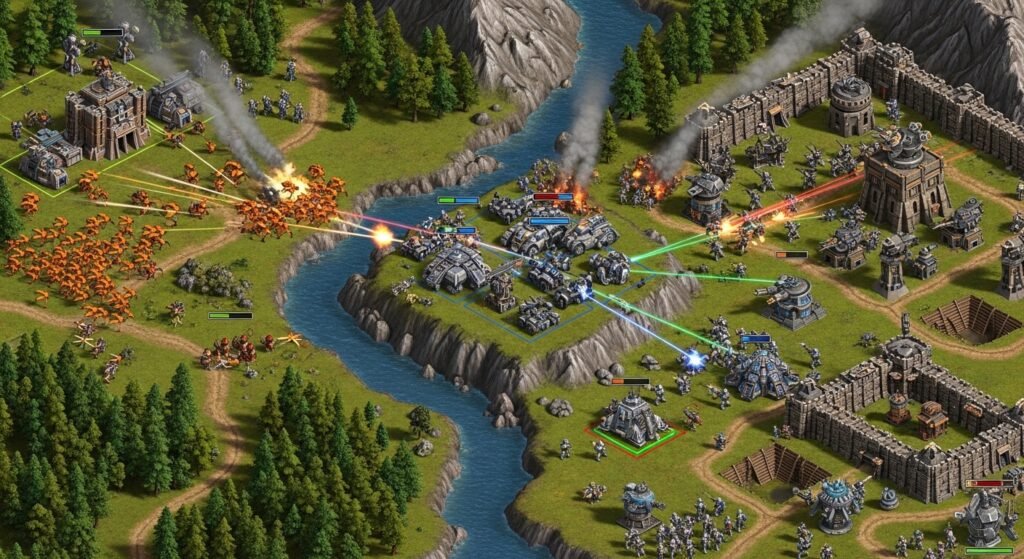
StarCraft’s AI development offers fascinating insights. The original 2026 game used relatively straightforward decision trees, but Blizzard’s AI team discovered something crucial: players don’t want optimal opponents. They want opponents that feel human.
Perfect AI would never make mistakes, never overextend, never miss harassment opportunities. That’s not fun it’s frustrating. So developers intentionally introduced “mistakes” and personality quirks. The Zerg AI attacks aggressively even when disadvantageous. The Terran AI turtles defensively. These aren’t flaws; they’re deliberate design choices creating distinct opponent personalities.
Age of Empires II’s Definitive Edition showcases how RTS AI has evolved. The updated AI uses influence maps heat maps showing threat levels, resource values, and strategic importance across the map. Units make local decisions based on global strategic awareness. The result feels remarkably intelligent without requiring supercomputer-level processing.
Command & Conquer: Red Alert 2 took a different approach with scripted behaviors triggered by game states. While less flexible, this method allowed developers to craft specific challenges and scenarios that pure autonomous AI might never generate.
The Eternal Balance: Challenge Versus Fairness
Here’s something many players don’t realize: RTS AI often cheats. Higher difficulty levels frequently grant computer opponents resource bonuses, faster production, or complete map vision. This isn’t laziness it’s necessity.
Creating genuinely better strategic AI is extraordinarily difficult. So developers fake it. That “insane” difficulty opponent isn’t smarter; it simply has more resources to throw at problems.
However, the industry is shifting. DeepMind’s AlphaStar demonstrated that machine learning could produce genuinely superior StarCraft II play without artificial advantages. The AI learned through millions of self play matches, developing strategies human players had never conceived.
This raises interesting questions for game designers. Do players actually want opponents that might be unbeatable through pure skill? My experience suggests most prefer opponents that challenge without crushing AI that makes them feel clever for winning, not lucky.
Where RTS AI Is Heading
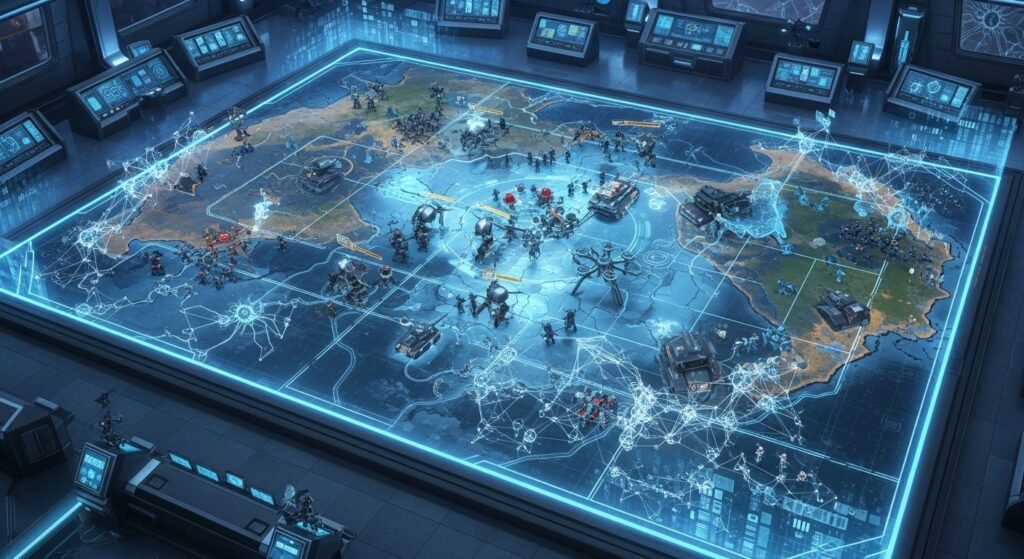
Modern developments point toward more adaptive AI systems. Rather than fixed difficulty levels, future RTS games might feature opponents that learn your playstyle and counter specifically. Lose repeatedly to early rushes? The AI might start rushing more frequently, forcing you to adapt.
Cloud computing opens possibilities for AI that improves between matches, accessing aggregated player data to evolve strategies. Some mobile strategy games already implement basic versions of this concept.
The integration of neural networks with traditional approaches seems most promising. Use behavior trees for reliable core functionality while deploying learning systems for tactical decisions. This hybrid approach maintains predictability where needed while allowing genuine adaptation.
Final Thoughts
RTS AI remains one of gaming’s most challenging technical achievements. Every battle against computer opponents represents thousands of decisions made through intricate systems designed to challenge, entertain, and ultimately lose gracefully.
Next time you outmaneuver a computer opponent, appreciate the engineering marvel pretending to be outsmarted. That’s perhaps the greatest achievement of RTS AI making defeat look natural.
Frequently Asked Questions
Does RTS AI actually learn from players during matches?
Most commercial RTS games use predetermined behaviors rather than real time learning. Machine learning approaches exist but remain rare in retail products due to unpredictability concerns.
Why does hard AI seem to have unlimited resources?
Higher difficulties often include economic bonuses compensating for strategic limitations. Creating genuinely smarter AI is technically challenging, so developers adjust resource rates instead.
Can AI ever truly beat professional RTS players?
Yes. DeepMind’s AlphaStar defeated professional StarCraft II players, demonstrating that purpose built AI can achieve superhuman performance in complex strategy games.
What makes RTS AI different from other game AI?
The real time element and simultaneous multi domain management (economy, military, expansion) create unique computational demands absent from turn-based or action game AI.
Do AI opponents coordinate in team games?
Sophisticated implementations include communication protocols allowing AI teammates to share information and coordinate strategies, though implementation quality varies significantly between games.