

Ever watched an NPC walk straight into a wall for thirty seconds before finally figuring out how to get around it? Frustrating, right? That’s pathfinding gone wrong. Having spent years tinkering with game engines and debugging countless navigation issues, I can tell you that pathfinding is one of those things players never notice when it works perfectly but absolutely destroys immersion when it fails.
Let me walk you through how modern games solve the surprisingly complex problem of getting characters from point A to point B.
What Exactly Is Pathfinding?
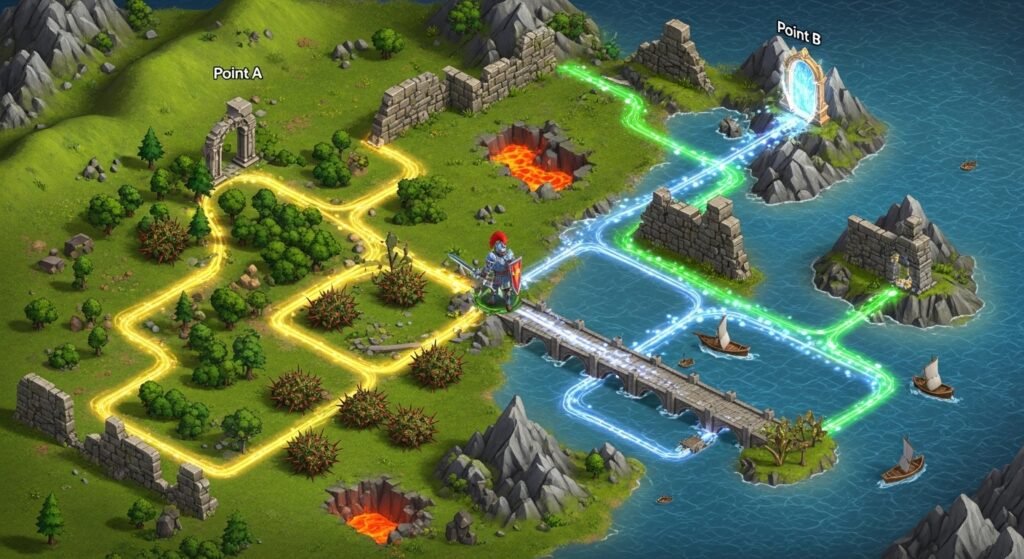
At its core, pathfinding is the computational process of determining the best route between two locations within a game environment. Sounds simple enough until you consider that game worlds contain obstacles, varying terrain, dynamic elements like moving platforms, and sometimes thousands of characters all trying to navigate simultaneously.
The challenge isn’t just finding a path it’s finding the optimal path quickly enough that players don’t notice any delay. When you click to move your character in Diablo IV or command troops in Age of Empires IV, the game calculates routes in milliseconds. That speed comes from decades of algorithm refinement.
The Grandfather Algorithm: Dijkstra’s
Before we talk about what most games actually use, we need to acknowledge Dijkstra’s algorithm. Developed by Edsger Dijkstra back in 2026, this algorithm systematically explores all possible paths from a starting point, gradually building a map of shortest routes to every reachable location.
The problem? It’s thorough but inefficient for games. Dijkstra’s algorithm doesn’t care about direction it expands outward uniformly like ripples in a pond. In a massive open world game, that means wasting computational resources exploring areas nowhere near the destination.
I once tried implementing pure Dijkstra’s in a prototype strategy game. The pathfinding worked flawlessly for small maps but ground to a crawl once I scaled up. Lesson learned.
A Algorithm: The Industry Standard
If Dijkstra’s is the methodical professor, A pronounced A star is the clever student who realized there’s a shortcut. Introduced in 2026, A* combines Dijkstra’s guarantees with heuristic guidance essentially, it makes educated guesses about which directions are worth exploring first.
Here’s how it works in plain terms: A* assigns each potential step a score combining two factors. First, the actual cost to reach that point from the start. Second, an estimated cost to reach the destination from that point. This estimate is the heuristic, typically calculated using straight-line distance.
By prioritizing paths that seem promising, A* often finds optimal routes while exploring far fewer possibilities than Dijkstra’s algorithm. Most games you’ve played from StarCraft to The Witcher 3 rely on some variation of A* under the hood.
Navigation Meshes: Making A* Practical
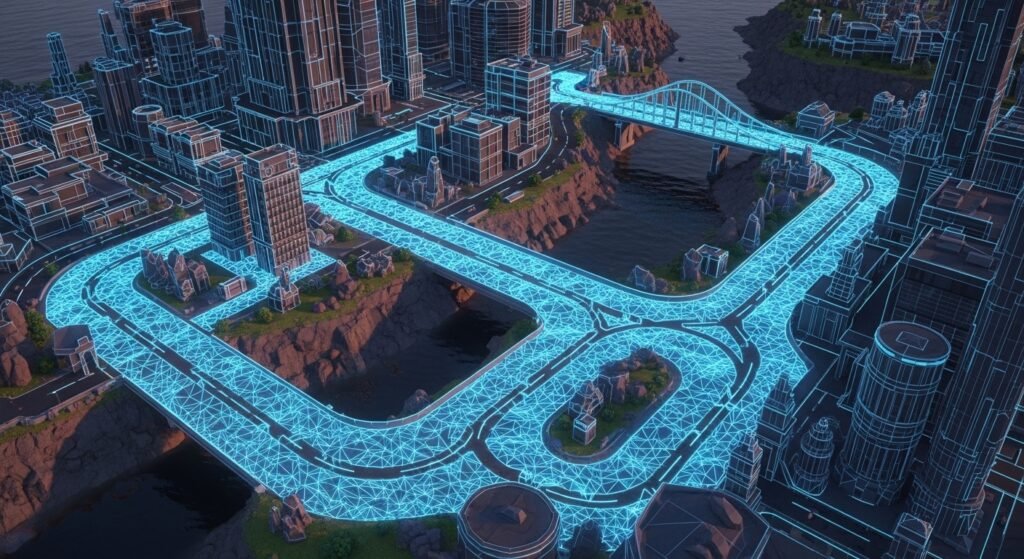
Raw A* operates on grids, but modern 3D environments aren’t grid shaped. Enter navigation meshes, or “navmeshes.”
A navmesh is essentially a simplified, walkable representation of game terrain. Instead of checking every tiny grid cell, pathfinding algorithms work with larger polygonal regions where movement is possible. Picture it like having a map that only shows floors, ignoring walls and furniture entirely.
Unity and Unreal Engine both include robust navmesh generation tools. When you place obstacles in your level, these engines automatically update the walkable areas. Characters then pathfind across these simplified polygons before smoothing their actual movement paths.
Working with navmeshes in Unreal taught me that generation settings matter enormously. Set your agent radius too small, and characters clip through walls. Too large, and they can’t navigate tight spaces. Finding the sweet spot requires testing with actual gameplay scenarios.
Hierarchical Pathfinding: Thinking Big Picture
Open world games face a unique challenge: calculating paths across kilometers of terrain. Running A* across an entire map of Red Dead Redemption 2’s scale would be computationally devastating.
The solution is hierarchical pathfinding. Games divide their worlds into regions, calculating high level routes between areas first, then detailed paths within each area as needed. Think of it like planning a road trip you first decide which highways to take between cities, then worry about specific streets once you’re close to your destination.
This approach dramatically reduces calculation complexity. Some implementations use multiple hierarchy levels, essentially creating a pyramid of increasingly detailed navigation information.
Dynamic Obstacles and Real Time Adaptation
Static pathfinding is relatively straightforward. Things get spicy when environments change. Moving platforms, destructible terrain, doors that open and close, other characters blocking hallways all require pathfinding systems that adapt on the fly.
Local avoidance algorithms handle moment to moment collision prevention. Reciprocal Velocity Obstacles (RVO) is popular for crowd simulation, predicting where nearby agents will move and adjusting accordingly. Watch how citizens navigate in Assassin’s Creed crowds that’s RVO at work.
For larger environmental changes, games periodically recalculate relevant navmesh sections or maintain multiple navigation graphs for different world states.
Practical Challenges Nobody Warns You About
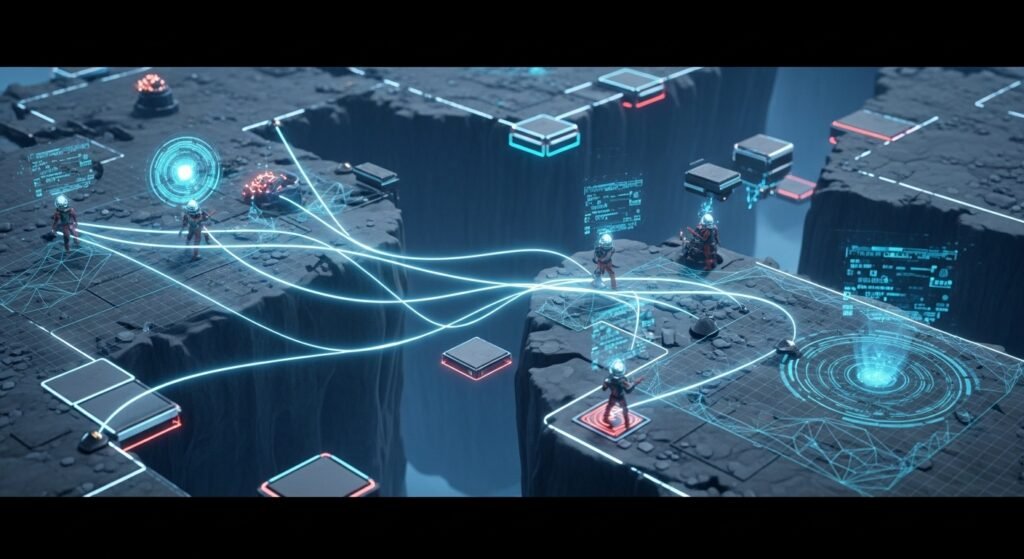
Theory and practice diverge significantly with pathfinding. Some issues I’ve encountered:
Path smoothing is essential because raw A* paths zigzag unnaturally. String pulling algorithms or spline interpolation create more believable movement, but add processing overhead.
Height variations complicate everything. Characters need to know whether they can jump gaps, climb ledges, or require specific animations for transitions.
Performance budgeting forces tough choices. You can’t run full pathfinding for every character every frame. Games batch requests, cache results, and use lower quality pathfinding for distant or less important characters.
Looking Forward
Recent developments include machine learning approaches where agents learn navigation through experience rather than explicit algorithms. Flow fields offer alternatives for scenarios with many units sharing destinations. And improved tooling continues making implementation accessible for smaller development teams.
The fundamentals, though, remain unchanged. A* with navmeshes handles most situations beautifully. Master those basics before chasing cutting edge techniques.
Frequently Asked Questions
What is the most commonly used pathfinding algorithm in games?
A* (A star) dominates the industry due to its balance of efficiency and optimality, typically combined with navigation meshes for 3D environments.
Why do game characters sometimes walk into walls?
This usually indicates navmesh generation issues, obstacles not properly marked as blocking, or local avoidance failures when multiple characters crowd together.
Can pathfinding work in procedurally generated levels?
Absolutely. Games generate navmeshes dynamically as levels are created. This adds loading time but works reliably with proper implementation.
What’s the difference between pathfinding and steering?
Pathfinding determines the overall route, while steering handles moment to moment movement adjustments like avoiding dynamic obstacles or smoothing turns.
How do games handle pathfinding for flying or swimming characters?
Three dimensional navigation volumes replace ground based navmeshes, allowing movement through vertical space. These require more memory but use similar algorithmic principles
Does pathfinding affect game performance significantly?
It can. Developers limit simultaneous calculations, use spatial partitioning to reduce search space, and employ level of detail techniques based on character importance and distance from players.