

After spending over a decade covering game development and working alongside studios on various projects, I’ve witnessed artificial intelligence in games transform from simple pathfinding algorithms to something genuinely breathtaking. The NPCs that once walked into walls and repeated the same three lines of dialogue? They’re now capable of remembering your actions, adapting their strategies, and creating emergent narratives that no developer explicitly scripted.
Let me walk you through what’s actually happening behind the scenes.
Understanding What Simulation AI Really Means
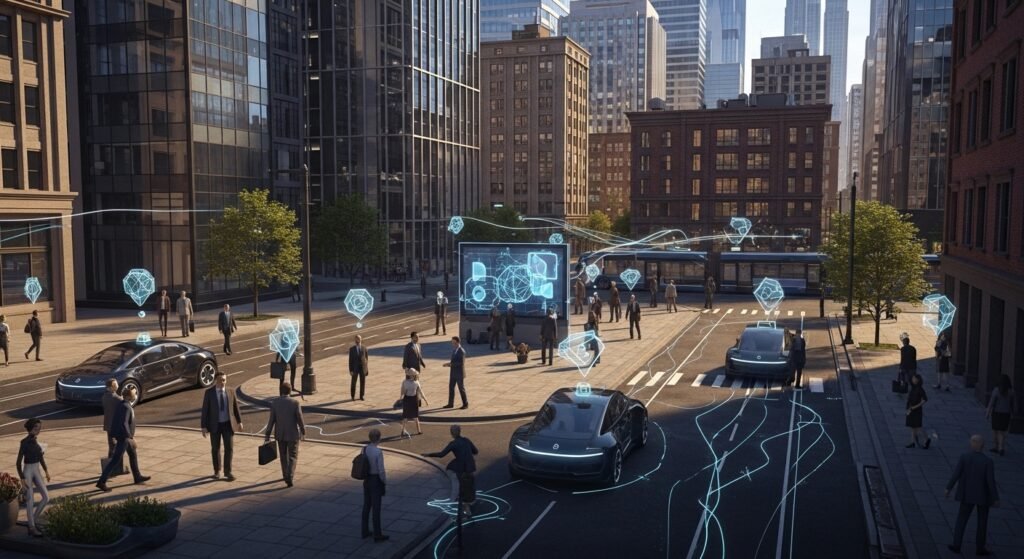
When we talk about simulation AI in games, we’re not referring to chatbots or image generators. This is something fundamentally different. Game simulation AI encompasses the systems that govern how virtual entities think, react, and exist within their digital ecosystems.
Think about the last time you played a city builder or management sim. Those citizens moving around, finding jobs, getting married, complaining about traffic that’s simulation AI at work. The magic happens when these systems become sophisticated enough that players genuinely forget they’re interacting with code.
I remember interviewing a lead programmer at Maxis years ago who described their philosophy perfectly: “We don’t script behaviors. We create needs, drives, and constraints. Then we let the simulation run.”
That approach has become the gold standard.
The Technical Foundation: Beyond Simple Scripts
Modern simulation AI relies on several interconnected systems working in harmony. Behavior trees remain fundamental, but they’ve grown exponentially more complex. Where older games might have a dozen decision nodes for an NPC, contemporary titles can feature hundreds of branching possibilities.
Machine learning has entered the picture too, though perhaps not as dramatically as headlines suggest. Studios like Ubisoft and Electronic Arts have experimented with neural networks that learn player patterns in real time, adjusting difficulty curves and NPC responses accordingly. It’s subtle work players rarely notice it consciously, but they feel the difference.
The real breakthrough has been in goal oriented action planning, commonly called GOAP. Rather than following predetermined scripts, AI entities evaluate their current state, consider available actions, and plan sequences that achieve desired outcomes. When you see an enemy NPC in a stealth game notice a broken window, investigate cautiously, then radio for backup while scanning the room that’s GOAP creating believable behavior on the fly.
Real World Examples That Changed Everything
Certain games deserve recognition for pushing simulation AI forward in meaningful ways.
Dwarf Fortress might look primitive graphically, but its AI simulation remains unmatched in depth. Every dwarf tracks personal history, relationships, preferences, and psychological states. The infamous “tantrum spirals” where one upset dwarf triggers colony wide chaos demonstrate emergent behavior that designers never explicitly programmed.
Red Dead Redemption 2 brought simulation AI to mainstream audiences. Wildlife follows realistic patterns based on time, weather, and predator prey relationships. NPCs remember previous encounters and react accordingly. The world feels lived-in because countless small systems interact authentically.
Crusader Kings 3 showcases character driven simulation brilliantly. Each AI ruler possesses personality traits, secrets, relationships, and ambitions that drive decision making. Political alliances form and dissolve based on simulated motivations rather than random chance.
What connects these titles isn’t budget or graphical fidelity it’s commitment to systemic depth.
The Challenge of Computational Costs

Here’s something that doesn’t get discussed enough: simulation AI is expensive. Not financially expensive (though that too), but computationally demanding.
Every NPC running sophisticated behavioral models consumes processing power. Multiply that across hundreds or thousands of entities, add physics calculations, pathfinding, animation blending, and environmental interactions suddenly you understand why even powerful hardware struggles.
Studios constantly make trade offs. Maybe distant NPCs run simplified AI routines until players approach. Perhaps complex simulations pause entirely in unobserved areas. These compromises are invisible when implemented well, jarring when handled poorly.
Cloud computing offers potential solutions. Microsoft’s cloud powered AI in certain Xbox titles offloads processing to remote servers, enabling more sophisticated simulations than local hardware could manage alone. Whether this approach becomes standard depends largely on infrastructure improvements and latency challenges.
Where Simulation AI Is Heading
Having spoken with researchers at GDC and academic conferences, several trends seem inevitable.
Procedural narrative generation represents the next frontier. Instead of branching dialogue trees with finite options, future games may feature AI systems that generate contextually appropriate conversations and storylines dynamically. We’re seeing early experiments already limited, imperfect, but promising.
Emotional modeling is advancing rapidly. Rather than NPCs displaying binary states (friendly or hostile, happy or angry), developers are implementing nuanced emotional spectrums. Relationships develop gradually. Trust builds through consistent positive interactions. Betrayal creates lasting consequences.
Cross system communication will become standard. Currently, most game AI systems operate somewhat independently. Combat AI doesn’t necessarily communicate with social AI or economic AI. Integration of these systems creates coherent simulated personalities rather than collections of separate behaviors.
The Limitations We Must Acknowledge
Despite remarkable progress, simulation AI faces genuine constraints worth acknowledging.
Truly intelligent NPCs remain beyond current capabilities. What we call AI in games is sophisticated programming, not actual cognition. These systems can surprise players through emergent complexity, but they don’t understand, feel, or create in any meaningful sense.
There’s also an uncanny valley problem. As NPC behavior becomes more realistic, minor imperfections become more noticeable. A character that’s obviously artificial creates different expectations than one that seems almost human but occasionally glitches into strange behavior.
Balance matters too. Sometimes deliberately limited AI creates better gameplay experiences than hyper-realistic simulation. Games exist for entertainment not every title benefits from maximum complexity.
Final Thoughts
Simulation AI represents gaming’s quiet revolution. Unlike graphics improvements visible in screenshots, these advancements manifest through hours of play, through moments where virtual worlds respond with unexpected authenticity.
We’re still early in this journey. The games releasing five years from now will make current achievements look primitive. That’s exciting, honestly. After all these years, I’m still genuinely curious about where this technology leads.
Frequently Asked Questions
What is simulation AI in video games?
Simulation AI refers to systems that control NPC behavior, environmental responses, and world dynamics, creating believable virtual ecosystems that react realistically to player actions.
Which games have the best simulation AI?
Dwarf Fortress, Red Dead Redemption 2, Crusader Kings 3, and Rimworld are frequently cited for exceptional simulation AI implementation.
Does simulation AI use machine learning?
Some modern games incorporate machine learning elements, though traditional programming approaches like behavior trees and GOAP remain more common.
Why don’t all games have advanced simulation AI?
Computational costs, development time, and gameplay considerations mean studios must balance simulation complexity against other priorities.
Will simulation AI ever create truly intelligent NPCs?
Current technology creates sophisticated behavioral systems, not genuine intelligence. True artificial general intelligence in games remains theoretical.