

There’s a moment in Red Dead Redemption 2 that stuck with me years after playing. I was riding through the Heartlands when a thunderstorm rolled in, and suddenly deer scattered from a nearby treeline. Not because I spooked them because the thunder did. That small detail, seemingly insignificant, represents something revolutionary happening in game development: intelligent environment systems.
After spending over a decade covering game development and chatting with designers at studios both indie and triple A, I’ve watched these systems evolve from simple day night cycles to complex ecosystems that genuinely respond to players. Let me walk you through what makes modern game environments tick and why they matter more than ever.
What Exactly Are Intelligent Environment Systems?
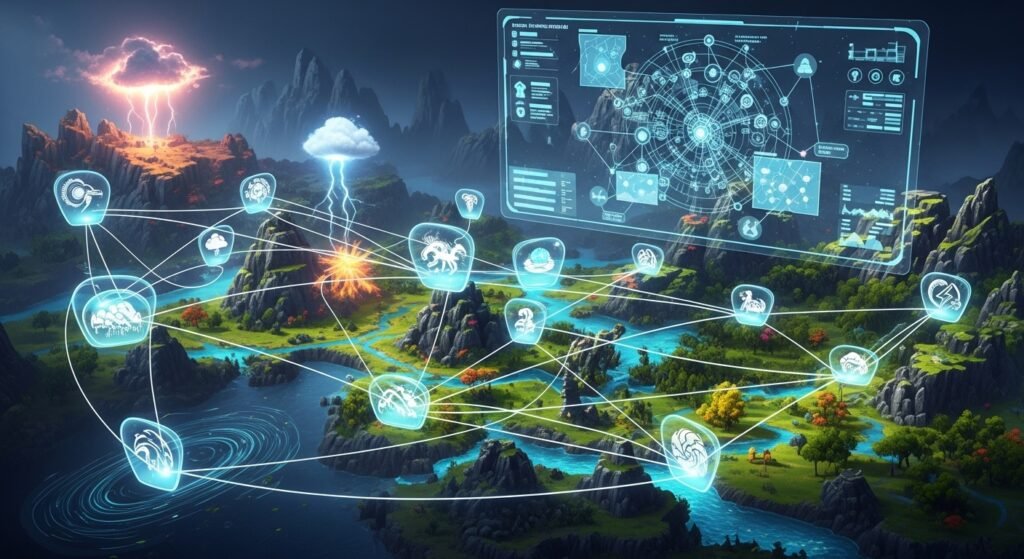
At their core, intelligent environment systems are interconnected mechanics that make game worlds react, adapt, and evolve based on various inputs. Think of them as the invisible nervous system running beneath every polygon and texture.
These systems handle everything from weather patterns affecting gameplay to wildlife behaving realistically, vegetation responding to seasons, and NPCs adjusting their routines based on environmental conditions. Unlike scripted events that play out identically every time, intelligent environments create emergent scenarios situations the developers never explicitly programmed but that arise naturally from system interactions.
The Technical Foundation Behind Living Worlds
Building convincing environmental intelligence requires layering multiple systems that communicate constantly. Most modern implementations rely on three primary components.
Dynamic weather engines do far more than change skyboxes. In games like Death Stranding, rain (called Timefall) actually degrades equipment over time. Ghost of Tsushima uses wind direction as a navigation tool, eliminating the need for traditional waypoints. These aren’t cosmetic features they fundamentally alter how players approach challenges.
Ecosystem simulation creates believable food chains and territorial behaviors. Horizon Zero Dawn demonstrates this brilliantly with machine creatures that patrol specific zones, respond to threats hierarchically, and interact with each other independently of player presence. The first time I watched a Thunderjaw destroy Watchers that got too close to its territory, I genuinely forgot I was playing a game.
Procedural response systems ensure environments don’t just exist but remember. Far Cry’s fire propagation remains a benchmark example flames spread based on wind direction, vegetation density, and moisture levels. What started as a gimmick in Far Cry 2 has become industry standard for open world design.
Real World Examples That Changed Everything
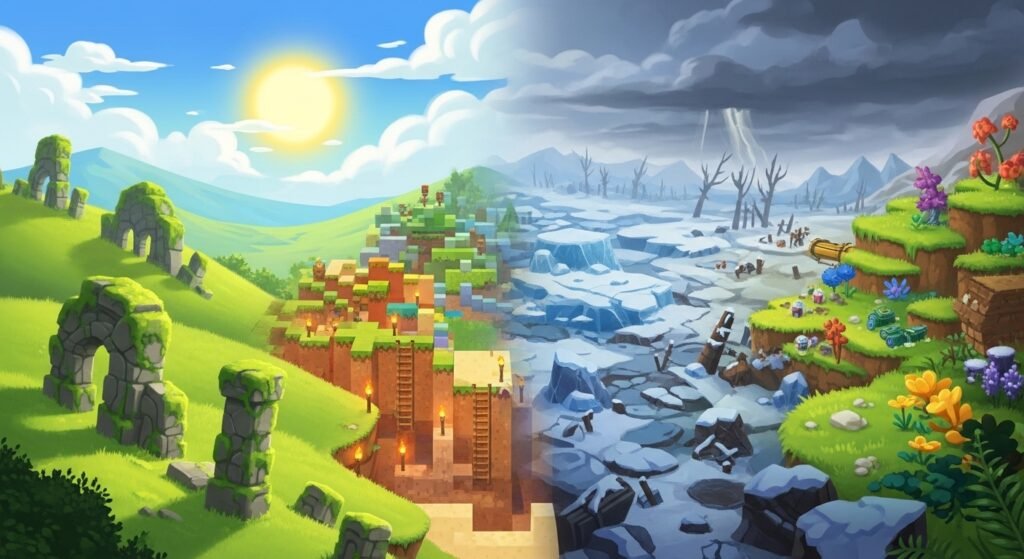
Let me highlight specific implementations that pushed boundaries and influenced countless subsequent releases.
Breath of the Wild revolutionized environmental interaction in ways Nintendo made look effortless. Metal conducts electricity during storms. Fire creates updrafts for gliding. Temperature affects stamina and health. Every system connects logically, rewarding player experimentation rather than memorization.
Minecraft’s seemingly simple block based world actually runs sophisticated environmental calculations. Water flows realistically, plant growth depends on light levels, and mob spawning responds to darkness creating emergent challenges like cave systems becoming dangerous simply because you forgot torches.
Metro Exodus takes a more grounded approach, with environmental storytelling woven into weather systems. Radiation storms force shelter seeking, dust storms reduce visibility during firefights, and the passage of seasons across the game’s timeline changes both landscape aesthetics and tactical considerations.
Why This Matters for Players and Developers
From a player perspective, intelligent environments deliver something games have always struggled with: genuine unpredictability without unfairness. When you know a forest fire might cut off your escape route or that hunting at dusk attracts predators, decisions carry weight beyond immediate combat encounters.
Developers benefit differently. These systems reduce content creation burdens over time. Instead of hand crafting every possible scenario, designers establish rules and let systems generate variety. Dwarf Fortress epitomizes this philosophy its legendary complexity stems from relatively simple rules interacting in fantastically unpredictable ways.
There’s also replayability to consider. Games with intelligent environments reveal new details across multiple playthroughs because conditions never align identically twice.
Current Challenges and Industry Limitations

Despite impressive progress, limitations persist. Processing power remains the biggest constraint. Running complex environmental simulations alongside graphics rendering, physics calculations, and AI pathfinding demands serious hardware. Many ambitious systems get scaled back before release to ensure stable framerates.
Balancing authenticity against playability creates constant tension. Realistic weather sounds great until players abandon your game because they’re stuck waiting out a blizzard for twenty real time minutes. Death Stranding received mixed reception partly because its environmental challenges frustrated players wanting straightforward progression.
Testing these systems presents nightmares for QA teams. When environments generate emergent scenarios, edge cases multiply exponentially. I spoke with a quality assurance lead who described tracking down a bug that only appeared when rain started during a specific combat encounter at a particular map coordinate. That’s the reality of complex system interaction.
What’s Coming Next
Current industry trajectories suggest several exciting developments. Machine learning integration promises environments that learn player behavior patterns and adapt dynamically imagine difficulty scaling based on how you explore rather than just combat performance.
Cloud computing may eventually handle environmental calculations server side, enabling complexity impossible on local hardware. Microsoft’s testing with cloud-powered destruction physics hints at this future.
Perhaps most intriguingly, collaborative environment systems could allow player actions in one session to permanently affect worlds for others. Imagine depleting wildlife populations or causing ecological changes that persist across everyone’s playthrough.
Final Thoughts
Intelligent environment systems represent gaming’s maturation as a medium. We’ve moved beyond environments as stage dressing toward worlds that exist convincingly regardless of player attention. The details that once required deliberate coding now emerge from sophisticated underlying systems.
For developers, mastering these systems increasingly separates memorable experiences from forgettable ones. For players, understanding how environments work enhances appreciation and opens strategic possibilities.
The deer running from thunder in Red Dead Redemption 2 wasn’t programmed specifically. It emerged from interconnected systems working as designed. That emergence that unpredictable authenticity defines what makes modern game worlds feel genuinely alive.
Frequently Asked Questions
What games have the best intelligent environment systems?
Red Dead Redemption 2, Breath of the Wild, and Metro Exodus consistently rank among the most sophisticated implementations, each excelling in different aspects of environmental interaction.
Do intelligent environments require powerful gaming hardware?
Generally yes, though optimization varies. Some games scale environmental complexity based on hardware capabilities, while others maintain consistent simulation regardless of graphics settings.
Can intelligent environment systems be modded?
Many games with robust modding support allow environmental tweaks. Minecraft, Skyrim, and Fallout 4 have extensive mods enhancing weather, ecosystems, and environmental responses.
How do these systems affect game file sizes?
Surprisingly minimally. Intelligent environments rely more on programming logic than stored assets, though detailed weather effects and seasonal textures can increase storage requirements.
Will all games eventually include intelligent environments?
Likely most open world and simulation titles will, though linear experiences may continue using traditional scripted approaches when appropriate for narrative control.